
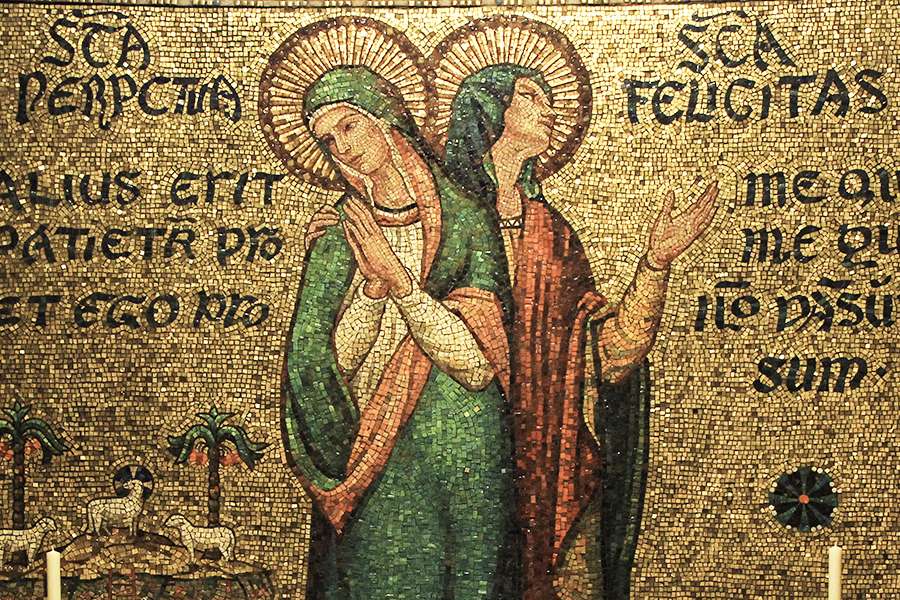
The text of the Martyrdom of Saints Perpetua and Felicity are, without a doubt, some of the raciest and most doctrinally controversial texts the church has in the patristic period – YET, these saints are hailed as saints by every church that bothers to name any saints at all. This text, containing the words, prophecies, and visions of these Martyr’s conveys to us a theology that pushes the boundaries on what a lot of people are comfortable with. While it needs to be noted of course, that these saints were young, and only catechumens upon arrest. They were not theologians or learned scholars, priests, bishops, or teachers. But young women who had only just been initiated into the Christian religion. Even so, they are canonical saints of the church, and holy Martyrs – WHO, regardless of their recent and hastily initiated state, claimed divine revelation. And that, with church approval and approbation. So, let’s dive right into it and see for ourselves what she said.
The text begins, The young catechumens, Revocatus and his fellow-servant Felicitas, Saturninus and Secundulus, were apprehended. And among them also was Vivia Perpetua, respectably born, liberally educated, a married matron, having a father and mother and two brothers, one of whom, like herself, was a catechumen, and a son an infant at the breast. She herself was about twenty-two years of age. … we were still with the persecutors, and my father, for the sake of his affection for me, was persisting in seeking to turn me away, and to cast me down from the faith,—‘Father,’ said I, ‘do you see, let us say, this vessel lying here to be a little pitcher, or something else?’ And he said, ‘I see it to be so.’ And I replied to him, ‘Can it be called by any other name than what it p 700 is?’ And he said, ‘No.’ ‘Neither can I call myself anything else than what I am, a Christian.’ Then my father, provoked at this saying, threw himself upon me, as if he would tear my eyes out. But he only distressed me, and went away overcome by the devil’s arguments. Then, in a few days after I had been without my father, I gave thanks to the Lord; and his absence became a source of consolation to me. In that same interval of a few days we were baptized, and to me the Spirit prescribed that in the water of baptism nothing else was to be sought for bodily endurance
Here we find the scene set for the occasion and the persons in this arrest and subsequent martyrdom. As this tale begins, with St. Perpetua herself tellin the story, what we first notice is the excruciatingly harsh persecution that they suffered at the hands of the Roman state. For one, the readers are made aware of the youth of Perpetua, who we are told is only about 20 years of age. Secondly of her situation, that she is a young mother with a new breastfeeding baby. Felicity too, we are told, was pregnant. And thirdly, the reader will note that their only crime was being Christian. To punish anybody for their Christian faith is already an unreasonable persecution. Yet we see here the intensity of the pagan hatred against the church in that these persecutions knew no bounds. Falling upon women, children, and even the pregnant also. The way that they were treated in this persecution was first with imprisonment. Perpetua tells us herself that this caused her great anxiety, specifically by reason of its darkness and solitude. As she herself says, After a few days we are taken into the dungeon, and I was very much afraid, because I had never felt such darkness. O terrible day! O the fierce heat of the shock of the soldiery, because of the crowds! I was very unusually distressed by my anxiety for my infant. However, her greatest suffering and anxiety as she tells us was not the darkness of the cell, nor the persecution itself, but her disconnection from her baby at a time in her nursing when it caused the baby to become malnourished and feeble, and which caused her great sadness and worry.
All along the way, her father and captors tried to reason with her, pleading that she renounce her faith, if not for herself then at least for her aged father and her newborn baby.Yet in the midst of this external suffering, the Lord gave her hope, encouragement, and strength. These come to her largely in the form of prophetic visions. In the first of these visions, it is revealed to her that she is to be martyred. In it is depicted a ladder that she must ascend, with dangers beside and below, to the end of reaching heaven at the top. At the bottom of the ladder is a dragon which seeks to scare away those who would seek to climb it. Yet as Perpetua says, in her vision the dragon is the one who is afraid of her. And she tramples upon its head and climbs the ladder in victory to the place of paradise where she is welcomed in by the Lord. As she recounts, my brother said to me, ‘My dear sister, you are already in a position of great dignity, and are such that you may ask for a vision, and that it may be made known to you whether this is to result in a passion or an escape.’ And I, who knew that I was privileged to converse with the Lord, whose kindnesses I had found to be so great, boldly promised him, and said, ‘To-morrow I will tell you.’ And I asked, and this was what was shown me. I saw a golden ladder of marvellous height, reaching up even to heaven, and very narrow, so that persons could only ascend it one by one; and on the sides of the ladder was fixed every kind of iron weapon. There were there swords, lances, hooks, daggers; so that if any one went up carelessly, or not looking upwards, he would be torn to pieces and his flesh would cleave to the iron weapons. And under the ladder itself was crouching a dragon of wonderful size, who lay in wait for those who ascended, and frightened them from the ascent. And Saturus went up first, who had subsequently delivered himself up freely on our account, not having been present at the time that we were taken prisoners. And he attained the top of the ladder, and turned towards me, and said to me, ‘Perpetua, I am waiting for you; but be careful that the dragon do not bite you.’ And I said, ‘In the name of the Lord Jesus Christ, he shall not hurt me.’ And from under the ladder itself, as if in fear of me, he slowly lifted up his head; and as I trod upon the first step, I trod upon his head. And I went up, and I saw an immense extent of garden, and in the midst of the garden a white-haired man sitting in the dress of a shepherd, of a large stature, milking sheep; and standing around were many thousand white-robed ones. And he raised his head, and looked upon me, and said to me, ‘Thou art welcome, daughter.’ And he called me, and from the cheese as he was milking he gave me as it were a little cake, and I received it with folded hands; and I ate it, and all who stood around said Amen. And at the sound of their voices I was awakened, still tasting a sweetness which I cannot describe. And I immediately related this to my brother, and we understood that it was to be a passion, and we ceased henceforth to have any hope in this world
Of course, the giving of visions and prophecies in the “church era” is itself controversial enough among Christians, but, putting that aside for now, the content of this first vision alone bespeaks to us several controversies. Firstly we have that of salvation being pictured as a ladder. This idea of salvation as a ladder that we climb is one that’s picked up in many of the Holy Fathers, as well as the medieval and modern theologians of both East and West. One might think, for example, of St. John Climacus’ Ladder of Divine Ascent, or the teachings of the Desert Fathers, of the Philokalia, or any such monastic or ascetical works. And all to the dismay of many Lutheran theologians, most of all we may mention those such as Gerhard O Forde (see, Where God Meets Man), Steven D. Paulson (Lutheran Theology), and even the good Dr. Martin Luther Himself, who holistically took complaint with the language of salvation as ascent. Their main issue with this being of course that salvation is one of free grace, unmeritted gift, and God coming us-ward rather than us moving God-ward. Yet, I want to bypass that entire discussion today and simply put this in a slightly different perspective for you. Instead of getting hung up on the metaphor of St. Perpetua’s vision, let’s look instead at its virtues. Firstly, she is picturing salvation as a ladder. A ladder is something that one climbs to go from low to high. This may be understood simply, from earth to heaven, or, from death to life, or, from damnation to salvation. Again – bypass the debate that may or may not be raging in your heads right now. Instead, look at Gen 28:10-22 and John 1:51 and the Johannine rendering of Jesus as Jacob’s Ladder. The main problem with the ladder theology that draws the complaints of Lutheran theologians is that it is usually assumed that the ladder itself that is to be climbed is works for merit, and that our climbing of that ladder is our effort. Yet understand this for an instance in another way. If the ladder is the way to salvation, what is it that we already know that way to be? Jesus Himself. If Jesus Himself is that ladder, if Jesus Himself is that way, if Jesus Himelf is that Narrow path, together along with the things by which we receive Him, the Sacraments of Baptism, of Confession and Absolution, of the Eucharist, and yes even the resurrected life that He has called us to live into, all of which – is not easy for St. Perpetua, but very difficult, and indeed caused her death, – then this becomes a metaphor. Not a teaching of works over grace. And this metaphor, not one unlike Jesus own, of Salvation as a narrow “way” or “path,” which one must walk. Yet nobody takes an issue with that. Yet if the direction is up rather than forward, everyone loses their minds over it. Take it at face value. There is a way to salvation, that way is Jesus. That way is baptism into Jesus. That way is the absolution of all your sin by the Word and procalation of Jesus. That way is the flesh and blood of Jesus received in the Holy Eucharist. That way is living your life in Jesus. That way is in all things Jesus. But that way must be “walked” as Jesus would say. Or, that ladder (who is Jesus), must be “climbed” as St. Perpetua would say. Yet the climbing of it is one that happens by grace. And, it is one that Satan tried his very best to get her not to do. With threats of prison, with pleas from her family, with the compassion for her newborn baby. Yet she cast all cares of the world off herself, even the love for her own baby – all of it sacrifice and left behind for her to walk that way and climb that ladder. The struggle, the effort, the work itself that is exhibited by St. Perpetua, and by all holy martyrs, IS the reception of grace in the Holy Sacraments. Yes she lived ascetically, but only because she was in prison for receiving the sacraments and confessing faith in Christ. Yes, she made great sacrifices for God, but only so that she could receive the sacraments and confess faith and Christ. And so YES, she did great things that took great effort. But the THINGS she did, the things she gave up, the suffering she endured, all of it, the entirety of it, was solely endured and done toward the end of receiving grace. Were it not so, she would have stayed away from baptism so that she could live 70 more years and toil in the soup kitchens and feed the homeless. If it were not so, she would have forsaken Christ in her confession, refused her baptism, and raised and loved her newborn child into adulthood to be redeemed by THAT good work. BUt in fact it was never so. And the Holy Fathers who wrote in this way, of salvation as ascent, of salvation as the climbing of a ladder, of salvation of the walking of a way, of a pilgrimage, of a work – it was always and entirely predicated upon the entrance into the divine life by free grace given in the Holy Sacraments and the Word laid hold upon through faithful confession.
In the second of her visions she sees her deceased brother, whom she prays for, and then sees in a vision that he is not only aided by her prayers for him but has been translated from the place of torment into paradise thereby. She says; After a few days, whilst we were all praying, on a sudden, in the middle of our prayer, there came to me a word, and I named Dinocrates; and I was amazed that that name had never come into my mind until then, and I was grieved as I remembered his misfortune. And I felt myself immediately to be worthy, and to be called on to ask on his behalf. And for him I began earnestly to make supplication, and to cry with groaning to the Lord. Without delay, on that very night, this was shown to me in a vision.4 I saw Dinocrates going out from a gloomy place, where also there were several others, and he was parched and very thirsty, with a filthy countenance and pallid colour, and the wound on his face which he had when he died. This Dinocrates had been my by brother after the flesh, seven years of age, who died miserably with disease—his face being so eaten out with cancer, that his death caused repugnance to all men. For him I had made my prayer, and between him and me there was a large interval, so that neither of us could approach to the other. And moreover, in the same place where Dinocrates was, there was a pool full of water, having its brink higher than was the stature of the boy; and Dinocrates raised himself up as if to drink. And I was grieved that, although that pool held water, still, on account of the height to its brink, he could not drink. And I was aroused, and knew that my brother was in suffering. But I trusted that my prayer would bring help to his suffering; and I prayed for him every day until we passed over into the prison of the camp, for we were to fight in the camp-show. Then was the birth-day of Gets Cæsar, and I made my prayer for my brother day and night, groaning and weeping that he might be granted to me.“Then, on the day on which we remained in fetters, this was shown to me. I saw that that place which I had formerly observed to be in gloom was now bright; and Dinocrates, with a clean body well clad, was finding refreshment. And where there had been a p 702 wound, I saw a scar; and that pool which I had before seen, I saw now with its margin lowered even to the boy’s navel. And one drew water from the pool incessantly, and upon its brink was a goblet filled with water; and Dinocrates drew near and began to drink from it, and the goblet did not fail. And when he was satisfied, he went away from the water to play joyously, after the manner of children, and I awoke. Then I understood that he was translated from the place of punishment
Again the controversy begins already from the get go. She “received a word.” If any would posit themselves charismatics, they ought to know that this is what they’re getting into. Yet, beyond this, what is it that this word and vision bring her to? It brings her to a vision which shows her that her brother who died young of cancer is in hell (or some place like it). This is controversial enough itself. Beyond this we have the controversy over what follows – her praying him out of hell and into heaven. Well how can this be? Is there such fate for young children who died unbaptized by no fault of their own? Is this purgatory? Is this hell? Nobody can seem to agree on what exactly is happening here. And her praying him out of this state? This is most especially striking of all. Yet – while these controversies themselves are far too sizeable for one simple blog article let me again try to lay those issues aside for you and restructure the perspective for you. The ideas here are simple – the unbaptized are not saved. A simple enough premise. Yet, fate, as Perpetua sees it, is not closed to those who dwell in wherever they dwell (be it hell, Sheol, or something akin to purgatory that she has in her mind). Those who fall into it, by no fault of their own at least, can be lifted out of it. We may assume that in her mind, at least according to this vision as she writes about it, cannot lift themselves out of it for whatever mind. But the Christian church has the power to lift them out of it by their prayers on behalf of those in darkness and death. The idea here is that the spiritual and the physical are not entirely separate but open all at once to God and therefore to those who dwell in God. thus we find not only the communion of the saints, but this ability, as it is spoken of, of the church both militant and triumphant to reach into the darkness and shed light there. How can this be? It is so even in our own realm of the “living.” All around us who are amdnot in the church are not alive but are dead. Yet what do we do? Do we leave them in there and say; “ah, well, they’re dead, so there’s nothing we can do?” Do we say; “ah, well, only he can lift himself up from death?” No , we don’t say that. Do we we say; “ah well you see only the Lord Jesus can save people, I can’t, so I wont do anything about this at all?” No! Rather, we pray for them to be converted, and we witness to them. Lest anyone think that pray here has no power and that witness alone has the power, remember first who prayer is toward and what It is for. It is to GOd, for Him to act and for Him to aid. Remember also, what your gospel witness to others is, at least in its efficacious and functional aspect; – it is the Word of God , through which we receive the Work of God, and the act of God. Thus, how comes conversion at all? The work of God. But is it accomplished by God without us? God forbid. It comes through us. We see this all the way form the beginning, with the patriarchs and the nation of Israel, with the prophets and the priests, with the Blessed Virgin Mary, through whom God sends His Son into the world, by taking flesh from her to redeeem the worl.d and then of course, through the Apostles, disciples, and whole church sent out into the world to preach the Gospel, to Baptize all nations, to feed the hungry, and to do the work of the God in the world. To be, as it were, the mystical body of Christ alive in the world, through which Christ makes Himself present to all the nations. So here we find that indeed it is true that God works through His church. Through the prayers of His church. Through the words of His church. Throguh the works of His church. Yet in all this, it is not His church which does them, but He Himself, speaking, acting, and working through His church, which is His body. Also, we have seen that indeed we already save those who are dead. And still also, that we have access to the spiritual. Again, is it us? No. But God through us. Is hell closed to God? Far be it from the case. are the spiritually dead further off from the physically dead? Far be it from being so. Are the prayers of Christ’s church unheard or unacted upon by God? Forbid it from being so. As such, while we may end up taking issue with St. Perpetua’s vision, we must choose the grounds we do so on very carefully, lest we slip and fall into some far graver error that we would ever accuse her of. Is it that prayer cannot save? Is it that God does not work through the church? Is it that God cannot save the spiritually dead? Is it that He cannot redeem the Physically dead? Is it that hell is closed to God? No, no, no, no, and also No. Honeslty, the best case against this (and all these controversies) is to deny the legitimacy or reality of dreams, visions, prophecies, and words of knowledge. But I’ll leave that argument there for you to wrestle with yourself
In the third vision she sees herself doing battle in the amphitheater not with the beasts that she expected but with Satan himself, whom she tramples upon the head of in victory, and she receives the prize for her conquest. In the fourth vision, which is given to Saturus, she and Saturus are brought by angels into the place of paradise where they see others who have been Martyred before them, and are welcomed in to greet the Lord. We read; And he called for silence, and said, ‘This Egyptian, if he should overcome this woman, shall kill her with the sword; and if she shall conquer him, she shall receive this branch.’ Then he departed. And we drew near to one another, and began to deal out blows. He sought to lay hold of my feet, while I struck at his face with my heels; and I was lifted up in the air, and began thus to thrust at him as if spurning the earth. But when I saw that there was some delay I joined my hands so as to twine my fingers with one another; and I took hold upon his head, and he fell on his face, and I trod upon his head And the people began to shout, and my backers to exult. And I drew near to the trainer and took the branch; and he kissed me, and said to me, ‘Daughter, peace be with you:’ and I began to go gloriously to the Sanavivarian gate.7 Then I awoke, and perceived that I was not to fight with beasts, but against the devil. Not ,such needs to be said of this beyond what was discussed with the vision of the ladder as much of that pertains to much of this. Yet it should or at least could be noted that there are a few interesting note to make here. First, we see that salvation here is pictured as a battle. This imagery most definitely comes form the writings of st. Paul, with the olympic combat, the Christian panoply, and so on. Yet here also we see that imagery of battle turned on its head. SHe is herself about to die, and be slain by combatants in the colosseum. Yet she has this vision of herself having the victor over a combatant (satan) in the colosseum and winning. Yet as we know, she actually wins this by her death. She puts satan to death through her own death. Here is a great lesson for us that many forget, and it Is connected there also to her beginning as a woman and being translated into a man, and also her trampling on His head. You will all of course remember (I hope) that the proto-evangelion, the first gospel of Gen 3:15 is as such – the seed of the woman will crush the head of the serpent. Yet much controversy exists over that regarding whether it is the SEED of the woman, or the woman herself who crushes the serpents head. Most early fathers render this toward the woman “and SHE will crush his head,” whereas nearly all modern translations render it as pertaining to the seed who is Christ, “and HE shall cursh his head.” But the reality is that there is no difference. In that Christ crushes the serpents head (which He does through His death), Mary crushes the head by giving birth to Christ the head-crusher. In that Christ crushes the head of satan through His death, in our nature, so also we are taken with Him into that victory. In that He enters into us and we in Him, we are taken with Him into that battle. In that He has put OUR sin to death through HIS flesh, 1 Pet, 2:24, (and OUR nature), so WE are given the power to trample upon the serpents and scorpions, and upon all the power of the devil (Luke 10:19). Thus we see that she is made a man because she is in Christ, the true man. Thus, in Christ she crushes the serpents head. Thus, in Christ she puts the devil to death through her own death. All this is Christ. Her in Christ, and Christ in her. The meaning, for those offended by this vision, is not to say that CHrist did not put the devil to death, but that He is inviting us to follow Him, and to become pictures and icons of Him, and of His cross, and of His victory. Thus as Christian Martyrs die for their faith, they embody the crucifixion and cross of Jesus that crushed satans head. Thus as Christian preachers proclaim the good news, heal diseases, and cast out demons, they embody the Christ who is that Gospel, that healing, and the binder of the strong man. Thus , as Pastors consecrate the bread and wine that it might be the body and blood of Christ, they do so in the person of Christ, as they speak His Words which alone hold the power to do such things. In all things the Christian power is Christ’s power. If there is any unifying message for us therefore in these 3 visions of St. Perpetua, as controversial as they may be, – it is this; that all things in us which have power are Christ. That our ascent toward God is only possible because of Christ, who is the way to the Father, and the ladder of Jacob. That not even the dead are too far gone for God, an that our prayers have power, because of Christ who entered into our death to redeem death, who hears our prayers and prays on our behalf, who holds the keys of death and hell, who plunders hades and sheol, and who liberates the captives, and raises the dead from their graves. That in Christ there is neither male nor female, jew nor gentile, slave nor free, but that all are one in Christ Jesus. That in Christ , even our deaths, martyrdom, and defeats are victories through HIS death on the cross. That in Christ, the one who has crushed the serpents head has given us all power and authority to tread on serpents and scorpions, and to trample on every power of the enemy. ALl of this through Christ. all of this in Christ. all of this by Christ. all of this – Christ.
In all of these visions the common theme is similar to that which is seen of the Martyrs in the book of Revelation. The martyrdom is not defeat but victory. Those who die by the hand of their persecutors are rewarded with eternal life and entered into paradise with their fellow combatants in the faith, and find themselves in the presence with the Lord. These visions provide hope to the martyrs and embolden them with a matyrial confidence which enables them to go bravely to their deaths, not seeing their deaths as an end but rather a beginning, and as victory rather than defeat.
What we see here is that the hope of the Lord and the faith of the Martyrs, whether delivered through visions, prayer, the fellowship of the saints, or by the Word and Sacraments of the Lord give to them a hope and a clear vision which makes prisons palaces and death be seen as the birth of new and eternal life. The martyrs of the church see this in connection with the Lord’s own passion and death. Which did not end in the finality of death as victor, but put death to death, and caused the resurrection to eternal life. In their going down to death in martyrdom, these saints of the church recognized that the descent to death and the ascension to heaven were one and the same ladder.


