
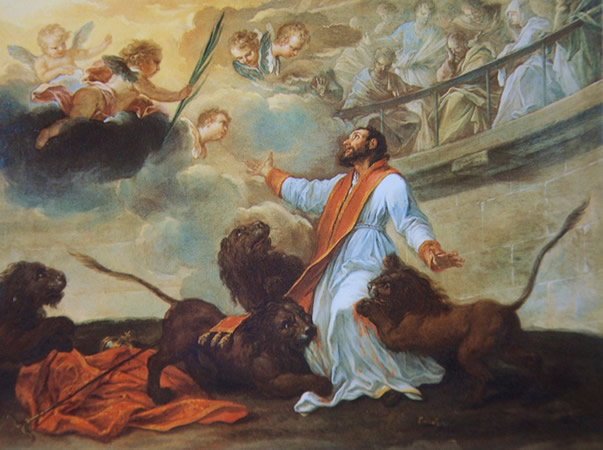
When one begins reading the letters of St. Ignatius (of Antioch) the first thing that they will notice is his emphasis on the Bishop and the presbyters in the church. While this offends a lot of protestants for reasons of fear of authority and clericalism, it is actually, for St. Ignatius (and all of the ancient Fathers), this authority and clericalism that he puts forward as their virtue, benefit, and beauty; particularly in regard to our submission to them, the unity signified and found in them, and the love that flows through them. It is their clerical office and the sacramental nature thereof which makes the office bearer, for the church, a living sign of the nearness of God together with His Word and Sacraments among and in the midst of His people. It is their authority over us, given to them by God through the laying on of hands and prayer that forms the familial relationship of care, protection, and guidance that they provide. And it is through our submission to them, that our pride and individualism is put to death, and unity, love, and sanctification begin to to grow.
Here is found also the distinction between the office of bishop and that of the presbyters. Over the course of his letters, St. Ignatius repeatedly returns to the topic of Bishops. For Ignatius, the Bishop is not simply the senior presbytery who is first among equals, but as he says, to the presbytery as the harp is to the strings. This meaning, they do not play or stand without or apart from him. This he says also of the Eucharist, of the church, and even of Christ. For the bishop is, as St. Ignatius says, Christ in, with, and among His people. And the people are to treat the bishop as if he were Christ. For St. Ignatius, the Bishop is not merely the sign of unity in the church, but the reality of it. In submitting to the bishop, the people show love for and submission to Christ. They are also by this, united into one, in accordance with the Law and the Gospel of God. Yet those who separate themselves from the bishop, being sectarians or schismatics, separate themselves not merely from an optional sign of unity, or form one possible leader, but they separate themselves from Christ, from the true Eucharist, and even from salvation.2 Part of this is because as St. Ignatius says, this matter of the bishop is not one that came about by the will of men, seeking authority, power, or effective function in ecclesiality, but from Jesus Christ Himself, saying in the letter to the Philadelphians, that he received this teaching not from men, but from God Himself.3 As such, to break with this or refuse this is to sin against the will of Christ, and as he enjoins upon this the warning from the Scriptures that “he that obeyeth not the Son shall not see life, but the wrath of God abideth on him.” For he that yields not obedience to his superiors is self-confident, quarrelsome, and proud.”4 Yet at the same time, it is because as he also says, the church is found where the bishop is, and so also the Eucharist comes through the Bishop and those to whom he has entrusted this authority.5 That is to say, in one way, they cut themselves off from salvation when they cut themselves off from the bishop because it is a sin against the institution and order of Christ Jesus Himself, yet also because it cuts themselves off from the blessings of this institution, namely the church itself, the Eucharist, without which, none will have salvation.
With respect to Christ our Lord, we see in Ignatius a deep understanding of the Mystery of Christ as both man and God. Yet also we see that there is deep understanding also in this work of the mystery of the Holy Trinity, and Christ’s place therein. As He says in his letter to the Ephesians, “our Physician is the only true God, the unbegotten and unapproachable, the Lord of all, the Father and Begetter of the only-begotten Son. We have also as a Physician the Lord our God, Jesus the Christ, the only-begotten Son and Word, before time began, but who afterwards became also man, of Mary the virgin.”7 Here in this creedally shaped statement we see that there is in Ignatius’ thought, a confession that Father is God, that the Son is God, and that there are not two Gods but one God. That yet still there is an understanding here that Jesus Christ, while being God, has taken on mortal flesh and been made man. That uncreated He was born of the flesh of St. Mary, and that though being the author of life He went down for us all the way to death. And in this we see that Ignatius sees all of this as a work of salvation for us along the salvific motif of healing, as by the great Physician, who is God, Father, Son, and Holy Spirit. This understanding of salvation as healing focuses our understanding of salvation in a concept of progress toward perfection, health, and wholeness. This we see also earlier in this same letter when he says to his readers; “I do not issue orders to you, as if I were some great person. For though I am bound for the name [of Christ], I am not yet perfect in Jesus Christ. For now I begin to be a disciple.”8 Here is seen that Ignatius understands humanity to be imperfect, sinful, and sick. Yet, at the coming of the great physician and as caused by His work on us and in us, we are brought closer to perfection in love and in goodness. This, St. Ignatius says, he has not yet arrived at. This is because there remained as he saw, imperfections and sickness of soul still within him. Thus, the act of salvation, for Ignatius, is not something merely accomplished by Christ and applied to us as a one time finished deal, but something that Christ is continually and progressively doing in us, through our Christian lives as He brings us closer to the perfection of Christ in us.
All of this work, as Ignatius states, is done by Christ. But not only in the past through His incarnation, life, suffering, death, and resurrection, but daily and always, through His means of the bishop, the presbyterys, and the community of the church, as well as Baptism and Holy Eucharist.
And in all of this, like with the sacrament of Holy Orders as found in the Diaconate, the Presbytery, and the Bishops, he emphasizes also unity in regard to the other sacraments. Saying in his letter to the Philadelphians; “you to have but one faith, and one [kind of] preaching, and one Eucharist. For there is one flesh of the Lord Jesus Christ; and His blood which was shed for us is one; one loaf also is broken to all [the communicants], and one cup is distributed among them all: there is but one altar for the whole Church, and one bishop, with the presbytery and deacons, my fellow-servants.”9 And “also one preaching, and one faith, and one baptism; and one Church which the holy apostles established from one end of the earth to the other by the blood of Christ.”10 The church then, for St. Ignatius, finds its unity, not only theologically or as an idea, but in concrete, and as lived out institutionally in its oneness of the institutional church, oneness in its confession of faith, oneness in its preaching. Just as St. Ignatius speaks of the Eucharist, which he confesses to be the body and blood of Christ, is from one loaf, and administered in one cup, so also it is administered by one bishop, and celebrated in the spirit of unity, love, and submission.
Thus, it is seen that Ignatius’s thought is holistically a thought focused on unity, love, and submission. It is one that focuses on Christ as present with His people, not only in becoming a man and taking on flesh as one of us, but present with us through the Bishops of the Church, through Baptism, the preaching of the Word, and in the Holy Eucharist. In all of this the church comes together as one, under one bishop, in one baptism, with one faith, one preaching, and living one way, in the holiness of the Father, the love of Christ, as we are empowered by the Holy Spirit so to do.


