
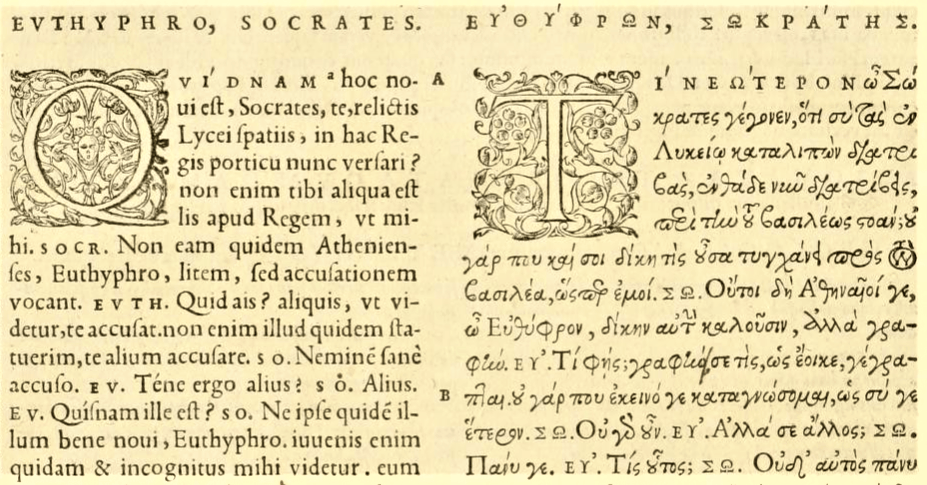
The diversion in trajectories between the Greek speaking Eastern Christians and the Latin speaking Western Christians begins first and foremost with a difference in language. While early on all Christians by and large spoke Greek, which was the lingua franca of the day, the west began to speak Latin. As this happened, gradually, the Latin church began to stop their use of Greek, and many of them became after a time were rendered entirely unable to read the Greek writings and fathers of the church. Whereas the Greek church seems to have never taken up the use of Latin, and so did not engage with the Latin works of the west. This linguistic division began in the 3rd century.1
The second factor that must be looked at here is the geographical distance between churches. With the western Latin church having its seat of authority in Rome but governing outward to the north of it they ended up with many of their churches being separated from the Greek Churches by either vast bodies of water, insurmountable mountain ranges, and lengthy distances of land that would all be necessary to cross over for them to reach. For this reason, many in the western church would very seldom, if ever, have come across Eastern Christians or go to those places themselves.
Along with this vast distance we have the political or governmental segregation of the western and eastern churches in the separation of the Roman empire into the two states, that of the western Roman Empire and the Eastern Roman empire in the last 3rd century.2 This also supported the distinction between the Church along these state lines, of the “western” church, which was found in the western Roman empire and of the “eastern” church which was to be found in the Eastern Roman empire. This distinction between state authorities then had even greater impact on the differences between the churches when the Roman empire in the west fell to the Germans in the late 5th century.3
While there was already some theological divergence between East and West in theological methodology and the acceptance and use of the Scriptures, some of which began very early, they were intensified by these linguistic, geographical, and political differences between the West and East that used to be more united at the time of Christ than they had become in the middle-Patristic period. As Chadwick notes, some of the Roman theologians tended toward more literal readings of the text, and were more comfortable with using St. John’s Revelation than were those in the East.4 Particularly, he notes that Justin Martyr, among others, read this text literally to the point of forming from it a Chiliastic Eschatology, looking forward to a literal one thousand year reign of Christ on the earth. While there were some in the east that shared Justin Martyr’s Literal approach to Scripture, such as Irenaeus, there were differences among them in what books they accepted as Scripture, as well as in regard to how those books were read and used.5
While there are now a great many differences between East and West liturgically, many of which began to develop very on in the history of the Church, one of those earliest differences was on the observance of Easter. This was perhaps one of the earliest and biggest factors in the alienation between East and West in the early church. As Chadwick recounts for us, the church of Rome did not originally celebrate Easter annually. But other churches in the East, such as the Christians of Antioch, did. Those in Antioch held the very ancient practice of celebrating Easter on the same day as the Jewish Passover. However, when Rome began to celebrate Easter, they did so on the Sunday following the Jewish Passover, as was done in Alexandria.6 However, Bishop Victor of Rome believed that Rome had received this practice from St. Peter and St. Paul, and demanded that all Christian churches, if they are truly Christian, must submit to Rome in this practice, and celebrate Easter on the Sunday following Passover.7 The East, naturally, especially those who were celebrating Easter on the day of Passover itself felt as though this was an abuse of power, and took the opportunity to point out the fact that Rome in fact not only did not receive their practice from the Holy Apostles, but had not been celebrating Easter on an annual basis at all until recently. Nevertheless, terms were used of Rome’s bishop in this instance as the “bishop of bishops” and the “pontifex maximus.”8 These titles, together with the way that Bishop Victor of Rome wielded his authority over the other bishops of the church, and his claim that they were bound to submit to him due to Rome’s origin as the see of St. Peter and St. Paul shows the early seed of what would later become the claim of the Papal supremacy of Rome over the global church. This here is one of the earliest accounts of a theme that would recur repeatedly in the history of the Christian Church until the great schism. It can and has been proposed that this factor developed independently of the others, as well as that it developed as a result of the others, such as the linguistic and geographical isolation form the Greek Church. However, whatever is the truth in this matter, we do know with certainty that the fruit of this was further alienation between the two Christian hemispheres and the beginning of a pattern of behavior and theological development from the Church of Rome and the entire Christian west that surrounded it.
In conclusion, when we look at the division between Western and Eastern Christianity we are looking at a development that took place over several centuries form the first point of the Easter controversy of the late 2nd century, the linguistic shift of the early 3rd century, to the splitting of the Roman empire in the late 3rd century, and the fall of the western empire in the 5th century. Here these dates, together with the difference in the use of biblical texts and the development of unique theological perspectives, together with their concept of the Roman bishop’s supreme authority over all churches, show for us the beginning of the western trajectory which finally climaxed in the Great Schism of 1054 when east and west finally broke fellowship completely from one another.
1Henry Chadwick, The Penguin History of The Church: The Early Church, Revised Ed., (London: Penguin Books Limited, 1993)., pp 91
2 Piganiol, André. “THE CAUSES OF THE FALL OF THE ROMAN EMPIRE.” The Journal of General Education 5, no. 1 (1950): 62–69. http://www.jstor.org/stable/27795332.
3Ibid.
4Henry Chadwick, The Penguin History of The Church: The Early Church, Revised Ed., (London: Penguin Books Limited, 1993)., pp 87
5Ibid.
6Ibid, 92
7Ibid.
8Ibid.


