
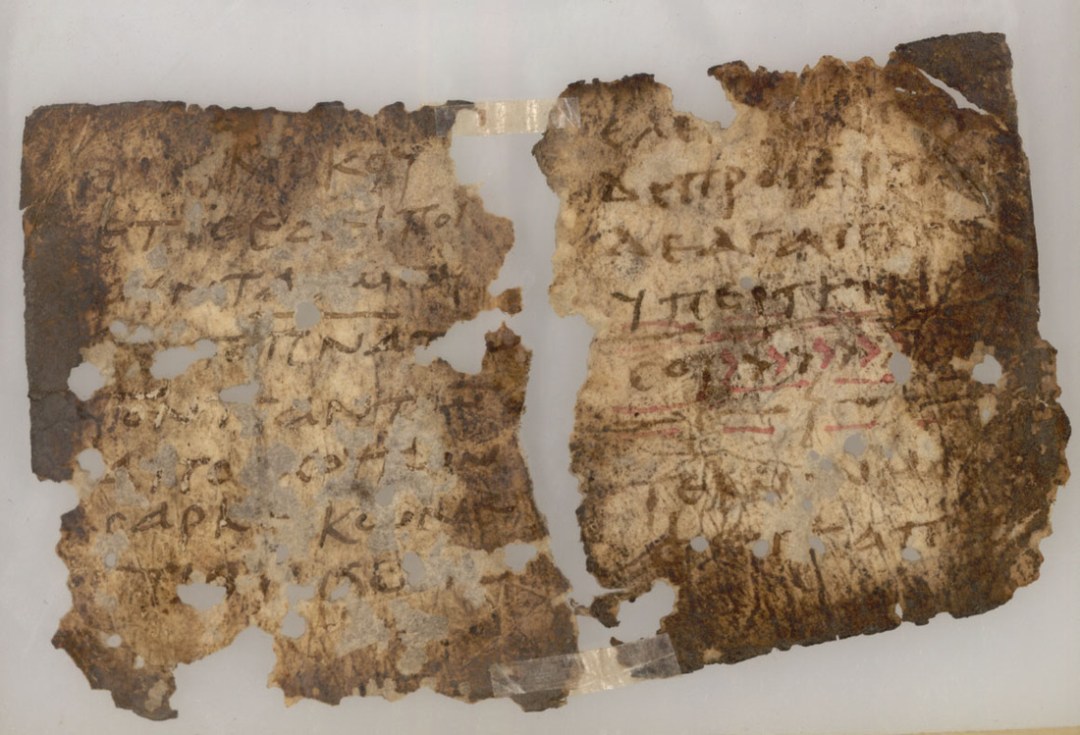
The Didache, which is perhaps the oldest of the church’s extra-biblical documents, is one that gives us a deep insight in the beliefs and practice of the early church. Whether they are actually written by the Apostles themselves or merely by early Christians living a the same time or shortly after the apostles, they give us a window into the earliest days of the church’s history. As a Christian living in the 21st century, and living in the context of so much confusion among the various different theological traditions that have arisen since, what always strikes me about the sacramental life of the Didache is first that it begins with Baptism. While this to us now is obvious, with the sacramental life of the church being understood to begin with Baptism, Chrismation, and the Holy Eucharist, it was in the text itself the Holy Eucharist that was instituted first, with Trinitarian Baptism being instituted afterward. Yet here in the Didache already we see that the order in mention is, despite that order, we see that Baptism is understood as the way of initiation into the Sacraments. Preceding this we have also a form of teaching preceding the Baptism, wherein the text reads; “And concerning baptism, thus baptize ye:16 Having first said all these things,” (referring to the moral teachings of the two ways, the commandments, the condemnation of sin, and of false teachers and idols).1 Here we see that the Didache is a sort of Catechetical Church order. Showing how Christians are to be made and initiated into the church. Beginning first with the catechetical teaching, then with Baptism, then with the Eucharist, and lastly with the living out of the Christian life within the context of the church.
The Baptism itself is said to be done not only after Catechesis but also preceded by fasting and prayer both on the part of the catechumen as well as the one baptizing. As the baptism is done. But for this baptism instructions and exceptions are given. Ideally, as the Didache lays out, this baptism is to be done in the Triune name, in what is implied to be immersion in cold living water. Yet then follow the exceptions. If living water is not possible, then still water is permitted. If cold water is unavailable then warm is acceptable. And if not by immersion, then pouring or sprinkling. This peaked my interest as this matter of the validity of baptism being tied to the form of triple immersion has arisen in our own age due to the differences in practice between East and West. Whereas the west has all but abandoned immersion in favor of pouring and sprinkling, the East insisted on retaining the Apostolic tradition of triple immersion. This dispute has itself led to the rebaptism of many western converts to Orthodoxy. Yet the text of the Didache has been used by the west in defense of its baptisms as valid, for the reason that in unfavorable circumstances it permits baptisms to be done through pouring and sprinkling. This has also led them to asking the East why, while they insist upon immersion they do not insist upon immersion into cold running water, but generally immerse into still water within the church setting.
Concerning the Eucharist, it is of great interest to me that already so early we have the Eucharistic prayer present in the early documents of the church. Where there is so little said about the liturgy in general, for the Eucharistic prayer here to be present, albeit in a primitive form, is telling for its importance to the Liturgy. While there is nothing said here of the offertory, or the kyrie, or the great liturgical hymns of the church, yet here stands the Eucharistic prayer in a form that while certainly different from its current one, is nevertheless recognizable as being organically connected to the same. Perhaps one could say that it was this prayer of thanksgiving that was seen as so inseparable form the sacrament of Our Lord’s body and blood that caused its designation of “the Eucharist” to arise in the first place. As we see also that the text of this prayer in the Didache says; “concerning the Thanksgiving (Eucharist), thus give thanks,” rather than giving this an example again tells us that this document functioned for the early church as a church order of sorts, telling those who read it exactly what to do down to the specific form of words, rather than just giving them a broad idea thereof.2 This prayer itself has to parts, one for before partaking of the sacrament and one for after. Before the partaking the prayer centers around Jesus as He is for us our king, the Son of David, our life and our knowledge. Here also is seen the connection between the church and these things, as the spiritual kingdom of God. Thus it is seen that the Didache speaks of the Eucharist not as a fellowship in community for community’s own sake, as many modern liberal Eucharistic prayer forms in the west would have it, but is centered around Jesus Christ Himself. Here is also added a warning for those who partake of the Eucharist, that it should only be received by those who are full communicant members of the church, having been first baptized (and therefore Catechized and well prepared).3 Following the reception of the Eucharist, we then see the second half of the prayer, which is in fact nearly twice the size of the first. Here in this second half the same concepts of Jesus Christ, His kingship, and His being our life, knowledge, and source of hope return. Yet here is also added a general thanksgiving for creation of material goods, such as the bread and wine used in the sacrament, as well as requests for God to deliver and save His church according to His promises.4
In these things we see that the sacramental life of the church as written of in the Didache is one that is, while admittedly “primitive,” very much recognizable as organically related to the same Liturgies done in the church in our present age. Yet it begs a few questions regarding the modern controversies over baptismal forms and their validity between East and West, as well as points us toward the centrality of the Eucharistic prayer for the Divine Liturgy, and for the Sacrament of the Altar itself specifically.
In my reflections on the Didache I find myself coming back every time to the simplicity of the document. While it is considered to be a document of church order, and rightly so, it remains itself to be one that is down to earth, practical, and simple in the best of senses. Beginning with the need to walk rightly before the Lord with the contrasting of the two ways, the commandments of the Lord, the condemnations of sin, and warning against false gods and false teachers, we see the preaching of repentance. Here we find the experience of the one hears that his works are evil, condemned before God, and will lead only to death. Yet here also is put forth a new way, the way of goodness, life, and repentance. Then we see the sacrament of baptism, with the catechesis, fasting, and prayers that prepare the candidate before hand presupposed. This shows us the moment of conversion and the reception of the candidate into the church. Then the document moves us onward toward the Altar where we see the Sacrament of the Eucharist, the source and summit of the Christian life and praxis, together teachings on the weekly rhythm of the Christian life; of sin, repentance, confession and absolution, Eucharist, and the amendment of life. Also within the Didache one finds teachings on the offices of the church and the relationship between her laity and officers. In all this we see a very simple and earthy walk through of a simple understanding of the Christian faith and life.
1 Alexander Roberts, James Donaldson, and A. Cleveland Coxe, eds., “The Lord’s Teaching through the Twelve Apostles to the Nations,” in Fathers of the Third and Fourth Centuries: Lactantius, Venantius, Asterius, Victorinus, Dionysius, Apostolic Teaching and Constitutions, Homily, and Liturgies, vol. 7, The Ante-Nicene Fathers (Buffalo, NY: Christian Literature Company, 1886), 379.
2 Alexander Roberts, James Donaldson, and A. Cleveland Coxe, eds., “The Lord’s Teaching through the Twelve Apostles to the Nations,” in Fathers of the Third and Fourth Centuries: Lactantius, Venantius, Asterius, Victorinus, Dionysius, Apostolic Teaching and Constitutions, Homily, and Liturgies, vol. 7, The Ante-Nicene Fathers (Buffalo, NY: Christian Literature Company, 1886), 379.
3 Ibid.
4 Ibid.


