
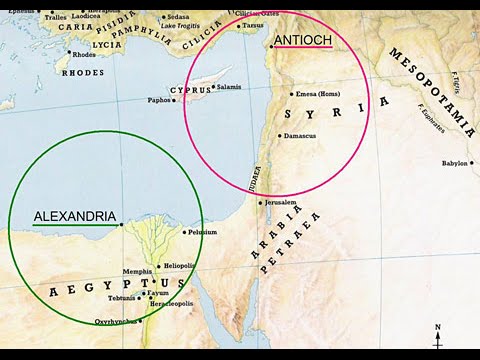
The hermeneutical difference between Alexandria and Antioch has long been discussed in the lecture halls of Christendom. Alexandria, as is known, was famous for the allegorical school of interpretation. This method itself was known to both Jews and Greeks in antiquity as well as in their own contemporary context, which we see mentioned both favorably and negatively by the Jewish Rabbis, by Plato, and by Philo of Alexandria, among others.1 We see this also in the Scriptures themselves as the Apostles read, understood, and applied the Old Testament Scriptures through this model, with an eye towards a Christocentric application of the Scriptures as we see in 1 Cor 10:4, Gal 4:22-31, and Heb 9:8-9. the purpose of this in the Apostles however, is not in an attempt to somehow escape the Scriptures which they are for whatever reason embarrassed by, but rather, it is used because they believed that these are the true meanings of the text. It was not out of fear for or embarrassment over the rock in the desert that St. Paul proclaimed it to be Christ, but because the true meaning of this rock was Christ in that it served as a type and pre-figurement of Him. Yet, as Alexandrian school of interpretation began to form itself into a concrete hermeneutical methodology, as used by such men as Clement of Alexandria, Origen, and St. Cyril, we see that there is somewhat of a variance in the reasoning and defense for this. Some of the fathers here defend this methodology on the basis of its apostolic witness and inherent truth. Such as the author of the Letter of Barnabas who states that those who engage in literal readings of the Old Testament not only miss out on the benefits of the spiritual substance but in fact totally misunderstand the point and meaning of those Scriptures, which, as he states, is Jesus Christ and His work of redemption.2 But others, such as Origen, defend this also on the basis of a fear of what more “literal” readings would communicate. He makes this exceptionally clear in his Prologue to the Commentary on the Song of Songs, wherein he states that the literal reading of Song of Songs would not fail to benefit the reader, but would in fact even harm them.3 Here as he makes clear his concern is that Song of Songs deals with material would, to those who view it with the eyes of the flesh, cause in them a surge of lust and sexual desire, which would be an entirely inappropriate response to the reading of religious texts. But rather, one must read this book he says with a spiritual understanding, seeing here a relationship between Christ and His church pictured through the allegory of the sexual union, and have through it an inspiration of love for Christ and desire for union with Him. He then relates this spiritual reading with the spiritual maturity of the experienced Christian, and the literal reading with that of the inexperienced Christians, who can only scratch at the most shallow levels of the Scriptures, unable to dive deeply into them.
The Antiochene School on the other hand focused on that of a literal approach. Or, what we might perhaps more accurately, and yet. anachronistically refer to as a historical-grammatical approach. This approach was one that was developed from a historical focus on the Holy Scriptures, especially as they look forward to and prophecy of the coming Christ. This school held up for itself men such as Ignatius. However, we see a similar approach to Scripture in use by such other men as Justin Martyr and Irenaeus.4 In their use of the literal interpretation, Jesus is still present as the overall purpose of the biblical canon, but He is so in the form of their end and purpose, rather than their immediate substance. Thus, the Old Testament is read primarily in relation to its own historical context, as that which leads up to Christ, and prophecies of the coming Christ, but is not itself a form of the substance of Christ.
Every time that I consider the allegorical and literal schools of interpretation I find myself always asking myself the same questions, regarding why both sides saw themselves as mutually exclusive toward the other. From my own perspective it seems obvious that both can and should very clearly coexist. On the one hand, the obvious base and root of the Scriptural meaning is their literal meaning couched within the historical and grammatical context of the text itself. Yet at the same time, if we refuse to acknowledge the deeper spiritual and allegorical meanings that are inherently held within the text, seen when cross referenced to other Scriptures, and also placed upon the text through an exercise of a hermeneutical or homiletical elasticity or imagination, we end up robbing ourselves of the richness and usefulness of the Scriptures. They become to us mere books of history and little more, so that they tell us of the context before Christ, and prophecy of Christ, but that they do not themselves deliver Him to us or that we cannot or should not see Him there for us. Yet on the other hand it would strike me as going far to overboard in saying that the literal meanings of the scriptures are a misuse of the Scripture and sometimes even harmful to us. Granted, this can be true in certain places, such as if we turn figures of speech in the literalisms, believing that God has seven spirits (Rev 4:5), or that trees have hands (Isa 55:12). But these examples are few and far between, and those who do not understand them are even fewer still. As I see it the truth is neither to be allegorical or literal but to be both at once. To recognize that there is a manifold use and purpose of Scripture. That there is truly a historical and grammatical meaning to the text but that its meaning and use by no means stops there. This, I am sure, is the best and most helpful use of the Scriptures.
1 Henry Chadwick, The Penguin History of The Church: The Early Church, Revised Edition, (London: Penguin Books Limited, 1993), pp. 83.
2 Kesich, 135
3 Origin, Prologue to the Commentary on the Song of Songs, p. 1-3.
4 Henry Chadwick, The Penguin History of The Church: The Early Church, Revised Edition, (London: Penguin Books Limited, 1993), pp. 83, 109


