
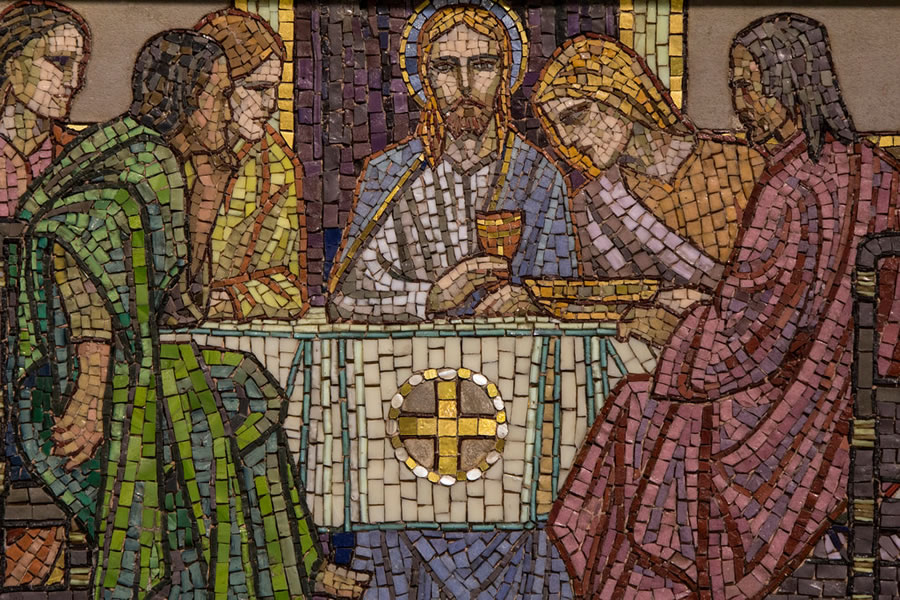
Today, if I may (and I may), I would like to take the chance to preach to you, catechetically about admission to the altar for the sacrament of communion. That is; who can come, who shouldn’t come, why and why not? And important thing to meditate upon at least, every now and then, for as we Confess in our Large Catechism part 5 v 1-2, it is IN FACT, essential, that we, as Christians KNOW these 3 chief things about it.
1. what is this sacrament (the body and blood of Christ)
2. what are the benefits of this sacrament, (the forgiveness of sins, life, and salvation)
and the 3rd and most often forgotten (or ignored) thing we MUST know, who is to receive this sacrament?
Of course, we’ve covered the first two of these questions nearly every Lord’s Day over the past 2 years. But today – we’re going to speak about the last of these. Now here – I am indirectly asking some of you to, if you can, perhaps unlearn some things. For others, to, for the first time ever to learn these things. So, if there are any questions, or anything is unclear at the end of this, of if you are shocked, or offended, or confused, – please; speak to me either after the service OR, at any time next week. Or ever, at any time. I only ask, that you receive what I have to speak to you today, with open hearts.
So, without further adue, my little catechumens, let us begin our catechism class, shall we?
Today our Lord speaks to us in a parable about this very matter, though He does so under veiled and hidden parabolic language. He speaks of a FEAST that a king was having. This king (that is, God, if you will) then sent His servants to go and summon all those that the He’d previously invited to this feast, that they might come and participate in it. But, His Word tells us, they did not want to come. That is, they rejected the call to come to the feast that had been invited to. The feast that had been prepared for them. They didn’t want it. Instead, they felt that they had better things to do. One, went to his farm. Another to the market. Others, probably were busy playing sports or going to see a play, I don’t know, but you get the idea. They felt they had more important things to do. And so, the King, sent out yet other servants to go and call them again. But this time the people didn’t just say no thanks, this time they had grown far too tired of hearing this never ending call to come and receive great and wonderful things form the king; free food, free wine, celebration, dancing, and fun – and so they beat up the servants and killed them all. The king then, furious, fuming, terribly mad, sent out his soliders to go and obliterate these evil people who murdered his servants, and then (because the party MUST go on) He sent his servants this time to go out and call in all the rabble from the streets, both good and bad, and to them He said to come in to this feast. AND THEY DID.
Well, and what is this about? Well let me explain this to you. The King is God. the feast is that which we heard about in Isaiah 25 and Psalm 23, it is the feast of victory, it is the feast of salvation, of fat things, and fine wines. It is our redemption worked out and completed, handed out and administered. And who are those that were invited but didn’t want to come (at least in the immediate context of Jesus’ parable)? They are those this feast of Isaiah 25 was prepared for, THE JEWS. And just as in this parable, the Jews rejected it. They rejected prophet after prophet. Stoning them. Abusing them, ignoring them, hating them, Killing them. Isaiah, Ezekiel, Jeremiah, Micah, the whole lot of them. This story of God’s people rejecting His servants is not FANTASY, but historical reality. This is true. This happened. This is still happening.
And just as in reality so also in this story, He sent again another servant, and another prophet, and yet another, and they were all rejected, they were all scorned, and they were all put to death. (so that Jesus, when Speaking of Jerusalem says, O Jerusalem, Jerusalem, the city which kills the prophets and stones those sent to them). That is what today’s parable speaks of, and last weeks does too, and so many others.
And so, as in reality so also in this story, He sent out His soldiers to go and put to death these viscous murders, and then sent out His servants again, to go out this time into the streets, and to call EVERYONE, as many as they found, and to invite them ALL to the wedding. And who are these? These are the gentiles. For as our Lord says elsewhere He came to His own but His own knew Him not, therefore, He went first to the Jews, but then after they rejected Him He went out to all nations. To call in ANY AND ALL who would come, IF indeed, they WOULD come. BOTH (our Lord says) the good and the bad. BOTH the wicked and the righteous. BOTH the Jew and the gentile (and indeed many Jews indeed DID end up coming, in the end). For indeed ALL were called to this feast – all who would come. In spite of, regardless of, what they had done, what they hadn’t done, what they knew, what they didn’t know, who they were, or who they weren’t. All – indeed, all – were invited to come. And so the hall was filled. It was filled with unworthy sinners. It was filled with street rabble. Not with well-to-do, worthy, or well-off noblemen, or landowners, or merchants; but with the homeless. With the dirty. With the poor. With the tax-collectors, and the sinners, and the prostitutes, and drug dealers, and all who would come – IF INDEED THEY WOULD COME.
But the parable is not yet done there, is it? NO – for among these people, that the King was pleased with – He saw one there who snuck in without a wedding garment (that is, the garment given to all who were invited by the king). And this man, who had come in by his own will, and wandered up to this feast because he felt as though he deserved to be there. Without an invitation, without a garment, without the will of the king for him to be there. And so, he was thrown out, into the outer darkness, and he suffered weeping and gnashing of teeth.
And this, my friends – this is exactly how salvation is. This, indeed, my friends, this is exactly how admission to the altar works. (because in fact they are the very same thing)
It is a feast of salvation, a feast of victory, it is in fact, our salvation itself freely given. It is forgiveness. And it is freely given to all who are invited. But there are some who don’t want to come. Who don’t feel that this sacrament is necessary for their salvation. And so, they cut themselves off FROM IT. There are some who feel that they have better things to do, who would rather tend to their work, or to their recreation, or to whatever else it may be that they find more important. These are those who reject the invitation. Those who do not WANT this forgiveness of sin, or this salvation, or do not want the body and blood of Christ FOR THEM, they should not come, and in fact, they wont come. – but what else do we see here? Who IS TO come? All WHO WILL. All who hear this good news, of God’s salvation worked out and finished on the cross of Mt. Calvary, in Christs’ flesh and blood, for the forgiveness of their sins, whether they are good or bad, righteous, or wicked, young or old, disabled or fit, 5 or 500, they – OUGHT – TO – COME. Indeed – ALL ought to come.
But there is yet a specific WAY that they are to come, isn’t there? That is, with this WEDDING GARMENT. And this garment, it comes, (historically that is) FROM the host, WITH the invitation. It is not something you have at home. It is not something you bring yourself. But something GIVEN TO YOU, by the host of the feast. This is, the garment of salvation that we hear of in Isaiah 61:10, wherein Isaiah prophesies himself of a wedding feast, saying;He has clothed me with the garments of salvation, He has covered me with the robe of righteousness, As a bridegroom decks himself with ornaments, And as a bride adorns herself with her jewels. And also in the book of Revelation chapter 6 and 7, wherein St. John tells us of how all the saints in heaven who enter in are given a white robe, – that is, the robe of their salvation, the robe of Christs’ righteousness. Which st. Paul tells us that we have all already received, truly, in our Baptism, when we PUT ON CHRIST, and are, as He says, CLOTHED WITH Christ. In the pure, white robe, of His righteousness, which covers us.
And so all who are to come to this feast of the wedding of the Lamb – ARE TO COME. But – they are to come Baptized. They are to come believing. They are to come, repenting. They are to come, not with their own worthiness, but with the robe of Christ’s righteousness given to them in baptism, and with His promise, that this feast is for them, for the forgiveness of their sins, and for the salvation of their souls. For as we confess of the admission to the sacrament of the altar – and quote; Those who are unrepentant and morally loose ought to be told to stay away, for they are not ready to receive the forgiveness of sins because they do not desire it and do not want to be righteous. [59] The others, however, who are not so callous and unrepentant but rather desire to be godly, must not hold themselves back or be kept away, even though in other respects they are weak and frail. As St. Hilary has also said, “Unless a person has committed such a sin that he has to be expelled from the congregation and has forfeited the name of Christian, he should not exclude himself from the sacrament,” lest he deprive himself of life. [60] For people never get to the point that they do not retain many common infirmities in their flesh and blood. [61] People with such misgivings must learn that it is the highest art to realize that this sacrament does not depend upon our worthiness. For we are not baptized because we are worthy and holy. Nor do we come to the sacrament of Confession BECAUSE we are pure and without sin; but rather, on the contrary, we come as poor, miserable people, precisely FOR the forgiveness of our sins. The only exception would be the person who desires no grace and absolution, rejects the reality of the body and blood,OR has no intention of repenting. [62] But those who earnestly desire grace and comfort should compel themselves to go and allow no one to deter them, saying, “I would really like to be worthy, but I come not on account of any worthiness of mine, but on account of your Word, because you have commanded it and I want to be your disciple, regardless of my worthiness
This is what we confess – as Lutherans. We do not confess any requirements other than this. I repeat – listen to me, we DO NOT, confess any other requirements than this. That you come knowing that you are a sinner in need of forgiveness, and come believing that in this sacrament you receive that very forgiveness, through the real, true, actual body given, and blood shed, for the forgiveness of your sins to be eaten and drunk in this Holy Sacrament. That is it.
There is no requirement for you to understand this. But only, that you accept it, and in no way reject it. For this is an unknowable mystery. And it is one offered to all. And it comes with no age requirement. It comes with no class attendance requirement. It comes with no righteousness requirement. But it comes to all – who will receive it, freely, – to the infirm, to the mentally disabled, to the young, to the sinful, and to all those on the streets who’ve never heard the name of Christ until we speak it to them. And it comes solely, wholly, and entirely on the basis of God’s free gift, together with the white baptismal robe of Christ’s righteousness, and the sealing of the holy spirit – so that in God’s claiming of these sinners, whoever they be, at whatever age they’re at, that God has claimed them, sealed them with His holy spirit, that He has given them ALL THINGS in Christ Jesus, and indeed – HOLDS NOTHING BACK. So – I ask you, (and please, hear this with an open heart), WHY SHOULD WE HOLD THEM BACK from what God has freely given them?
For there are those who are OLD and “confirmed” who do not CARE to even be here. There those who are OLD and “catechized” who REFUSE to repent of their sinful ways, and reject the very notion that their habits and lifestyles ARE broken and wrong. Yet to those who are here. Of any age. Who do believe that this is what Christ says it is. Who DESIRE IT and ASK FOR IT. And WANT IT. – Christ says of these – Let them come to me, and IN NO WAY hinder them, for the kingdom of God belongs to such as these. It belongs to those who just came in today. It belongs to those who havent attended catechetical classes yet. It belongs to the children. It belongs to the mentally disabled. It belongs to those addicted to drugs, pornography or alcohol., it belongs to the unlawfully divorced and the unsatable and the hurt, and the confused. It is the gift of having for the broken. The gift of Christ’s merits for the unworthy. The gift of God for the unholy.
It belongs – let me say it clearly, again – IT BELONGS TO ALL PEOPLE. For God has made it, prepared it, offered it, and GIVES IT, for and TO, all people. – so long as they will receive it.
And is this not just what we heard about in our readings today? Our God is preparing a feast for us, a feast of fat things, with the marrow, a feast of fine aged wine, a feast of victory and salvation, – this feast He has prepared for us, in the presence of all of our enemies, in the presence of sin, and of death, and suffering, and sorrow, and of the devil himself – this feast of Christ’s flesh, He has prepared for us upon Mt. Calvary, upon the place of the skull, upon Golgatha, upon the CROSS – He has prepared for us feast at His table, of His very own flesh, – and He has made our cup to overflow this His very own blood. – And now He invites us to come and to eat. To come, and to drink. To come, and to receive Him as He is for us. For as He says I the Lord, I have spoken – I the Lord have prepared a feast for ALL PEOPLE, and by this feast, and by this cross, I have, I am, and I will continue to destroy the shroud of darkness and the veil of death that covers all people. For on this mountain He says, I am taking away the rebuke of my people. By this Supper He says, I am swallowing up death itself. By this feast, and in this feast, and through this feast of the Lord’s Supper – of Holy Communion, of the Sacrament of the Altar, by this EUCHARIST – He says, I have am destroying death, forgiving sins, and saving souls.
Do you want this for yourself? Do you want this for all people? Then good, come. And bring others. Bring all. For as our Lord says in John 6; Most assuredly, I say to you, unless you eat the flesh of the Son of Man and drink His blood, you have no life in you. 54 Whoever eats My flesh and drinks My blood has eternal life, and I will raise him up at the last day. 55 For My flesh is food indeed, and My blood is drink indeed. 56 He who eats My flesh and drinks My blood abides in Me, and I in him.
Let us give this to ALL and as many as wish to be saved. For it is FOR salvation. And it Is FOR YOU. Whoever you are. It is – FOR YOU.
For He invites you now, and all people, to come, and to receive this salvation. For this is our God. Behold. We have looked upon and waited on and believed in Him – and He has come. And He has saved us. IN THIS SACRAMENT. Let us be glad and rejoice in His salvation. For today, it is given, to – and for– ALL – PEOPLE.
I repeat – FOR ALL PEOPLE.
And that means you too. In the name of F, S, & HS. Amen.


