
“And He was buried, and descended into Hell” – The Creed
As I mentioned last week, lots of things in Holy Week end up more or less getting thrown out and thrown away. But perhaps nothing has been more ignored than Holy Saturday.
And yet the irony is that perhaps of those days that get thrown out, beyond Maundy Thursday and Good Friday, nothing is more important than Holy Saturday.
In fact, of this full week, only Friday, Saturday, and Sunday’s events made it into any of the creeds. And of those creeds, Holy Saturday, and the burial of Christ makes it into not one, but two out of the 3 major ecumenical creeds (Apostles & Athanasian). And yet because this day and these texts and this part of the creed have been largely abandoned insofar as Holy Week attendance goes, it’s no longer only the uninitiated who fail to understand these lines in our creeds. And, in fact, the number of pastors I know who have the shared experience of their parishioners either protesting against the creed or staying silent for these particular lines of the creeds is no longer a small one.
And, in part, I get why this happened. It’s easy to miss it because it’s not as loud as the other days in the week. Perhaps because on the same day of Saturday (at night) most churches hold an Easter Vigil service which outshines and eclipses Holy Saturday itself. Obviously, we all get that. We all understand that. Maundy Thursday and Good Friday have special liturgies, and at least with Holy Monday, Tuesday, and Wednesday, although they aren’t flashy or eccentric, they aren’t bein outshined by one of the most elaborate celebrations of the church year.
But we simply cannot let this day go. It remains too important, too central, and too necessary. Of course, because of tradition, yes. Of course, because of it being part of our creeds and our confessions, yes. But most importantly of all, because of the theology that it brings into the Catechetical regimen of the church year. That is to say, that Holy Saturday, not only textually but thematically brings into the church year something that really isn’t found elsewhere. And that thing that’s found there is really mainly two things.
The first thing that Holy Saturday brings to our mind is of course the Limbus patrum, the harrowing of “Hell” and the distinction between sheol and Gehenna. And that’s an important thing itself. Why is it that we confess that Jesus went to Hell? Why? Technically because of a mistranslation of Hades. For Hell (Gehenna) and Hades (Sheol) are not the same place.
And the second thing that this day brings to our attention, is the Holy Silence of Our Lord’s Burial in the tomb. And that’s really what I want us to meditate upon this year. The Holy (that is, set apart, or special, or unique) silence, of Christ’s burial in the tomb.
And just what, you ask, is the Holy Silence of Our Lord’s Burial? Well, let’s go back to the way we started this Holy Week Journey, on Palm Sunday. What happens there?
They welcome in the King, the Messiah. They confess faith in Him. He does all these radical things, teaches all these new things about the fulfillment of the Covenant of God in His flesh, about Himself being the Son of God, about Himself giving us His flesh and blood to eat and to drink, about Himself forgiving our sins, about Himself being the only way to the Father – but then He starts to talk about how He’s going to die. And I don’t mean casually, or occasionally. Not as a one-off, but constantly as a never-ending refrain and obsession. The Son of Man has come to die. The Son of man must die. The Son of Man must be handed over to the chief priests and scribes and Pharisees and mocked and scorned and scourged – and die. I must depart. Where I’m going you cannot come. Soon I will leave you, Soon the light will leave you. For I must die. I must pass from this world, to my Father. For I must be lifted up as the serpent. For when I am lifted up, I will draw all men to myself. For the Son of Man must die. Again – and again – and again. Directly and indirectly. With great detail and in vague mystique. In passing, and in emphatic centrality. Again and again and again –
And then it began to happen just as He said it would.
He WAS betrayed. He WAS arrested. He WAS handed over. AND mocked – AND scorned – AND scourged. And – and – and – and everything He said would happen DID happen. …
Even the disciples’ abandonment. Every single one of them. Every single one of us. We turned away. We looked away. We ran away – while the high priests placed the Lamb of God upon the Altar of Sacrifice and the Romans put Him to death by way of crucifixion. And then, Life died.
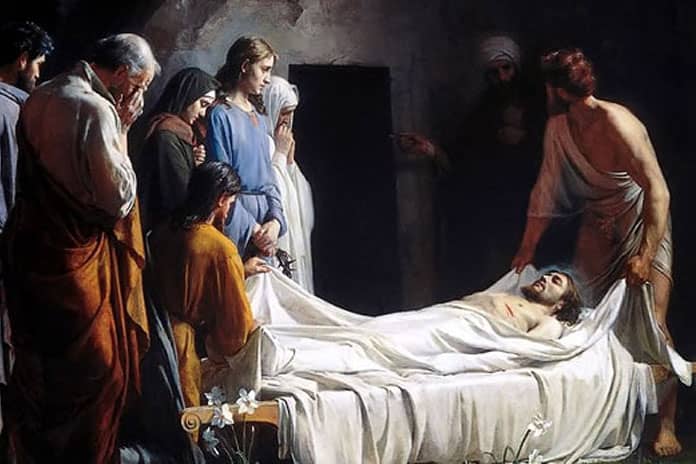
And then just like that, their messiah was gone. And then just like that their Rabbi, their teacher, their friend, their son, their brother, their God, our God – was dead and He was gone. Or at least, inanimate. Lifeless flesh hung in Mary’s arms. A lifeless corpse, wrapped in a shroud (a shroud we have by the way). And laid in a rich man’s tomb (A tomb we built a church in, by the way). These are real places and real things. For us – these are things of hope. Things of faith and things of the reality of the divine inbreaking into history that seems now only too far away. But that’s only because we live on the other side of the resurrection. But for those who were in it, if you will. These were things of utter hopelessness and crushing despair.
Because corpses do not speak, they do not act they do not move. They cannot assure you that your faith is placed in the right object. They cannot forgive you. They cannot instruct you. They cannot encourage you or comfort you. At BEST – this would have left them with an extremely tense feeling of anxiety and nervous anticipation. Is He coming back as He said? Is He the Messiah? Is He God? How could it be – look at Him. He’s dead. The Messiah doesn’t die. And if He can, then what good is He to the living?
And that is the power of this day. It says nothing. And in saying nothing, and in granting us this Holy Silence, the Feast of Holy Saturday gives us time to breathe and think and meditate upon what we’ve heard. And that is really what silence does, isn’t it? It doesn’t speak to us. It doesn’t give us new information. It doesn’t ask us any questions. It doesn’t do anything. It leaves us be. And let’s us do what we will. Silence forces us to be the presence in the room if you will. It forces us to be the one to ask the questions. It forces us to be the one to take the stand or to say the thing, or think the thought. It gives us space to do the action. And it’s in these times of silence (times we seldom get these days) when WE become active. Faith, let me say this dangerous thing that I’m about to say, faith – though created in us by God’s Word spoken and heard, is made manifestly alive and active in moments of silence. And unbelief – and the abandonment of faith, and the renunciation of hope – doesn’t happen during the sermon, but afterward, in moments of silence. It happens when we get home and nobody is watching. It happens when we have that choice, that decision to open the Bible or to open an incognito tab. It happens when we find ourselves afflicted by pain or suffering, or get that horrible diagnosis, or lose our job, or our marriage falls apart, or we lose a loved one, or the catastrophes and evil in the world break us down – and we think, and we wonder, have I just fooled myself? Is God real? Is Christ risen? Is this a fable? A myth? A fantasy?
And really, we see this in the disciples don’t we? What happens after Jesus is arrested? The disciples flee. Only John returns and stays to the end. Peter denies Christ three times and then goes fishing. The disciples form the first Ex-Vangelical support group. Nicodemus and Joseph bury Christ, and they do it in a very “this looks permanent” kind of way. The women go to bring burial spices for His corpse that they still think is dead and lifeless (spoiler alert, it’s not, but they don’t seem to know that). The only ones who actually seem to remember what Jesus said are the unbelieving Pharisees who make doubly sure to guard the tomb door so that nobody fakes a resurrection within 3 days to make Jesus’ words into a self-fulfilling prophecy, and the angels that meet the women at the tomb on Easter morning and are shocked by their short memories. Why are you looking for the living among the dead? DON’T YOU REMEMBER WHAT HE TOLD YOU? Or perhaps a more deeply probing question that the angels asked the women would be this, didn’t you believe the gospel He proclaimed to you? He told you He would meet you. And while the texts of the resurrection explain to us, that some began to believe, or first believed, or again believed, after the resurrection and that others still didn’t believe because they didn’t understand the scripture or the prophecies of the resurrection, – this is already seen in the actions they did, during this moment of Holy Silence. Silence elucidates either faith or unbelief. Either piety or apostasy. Either sanctification or sin.
That is the work of Silence.
And yet, in that silence, and in that tension, and in that paradox of hope and hopelessness – and anticipation and disappointment, in the silence, and in the stillness. Jesus was busy. He always is.
For while His body lay still, His soul moved about. While His body was secure there being lifeless in the tomb, Christ was busy going down to Hell to rescue the Spirits in prison, to plunder Hell of all its stolen treasures, and to bring His saints back into paradise with Him – into the presence of God, into eternal life, into the heavenly realm.
All of that, under the cloak, and in the shadow of the Holy Silence.
And as we meditate upon that, I want to draw this back into our own realities for us. Where are your moments of silence – and wh It’s all well and good to be at church, and to be around other Christians,
Even in the most hopeless of our hopeless moments (such as the burial was for Jesus’ disciples), God is busy at work. In these moments of toxic and sickening anticipation, when we’re filled with the despair brought on by the seemingly ever-present absence of God… those times hold some of His greatest works. Those times, silent though they seem, are some of the loudest battles between heaven and hell. Those times, empty those they seem are full of God’s action. Those times uneventful though they seem, are times when God is going to the lowest places to bring His saints to the highest heavens.
Where is God in the silence? He is in the grave, stealing the keys of Satan’s kingdom, Harrowing Hell, plundering prison, dethroning death, and rescuing the captives.
That is what you hear in the quiet, and in the nothing.
That is the proclamation of the unproclaimed Gospel.
That is the Holy Silence of Christ’s Corpse.
That is the Tone of the closed tomb.
That is the Gospel of Holy Saturday.
Amen.


