
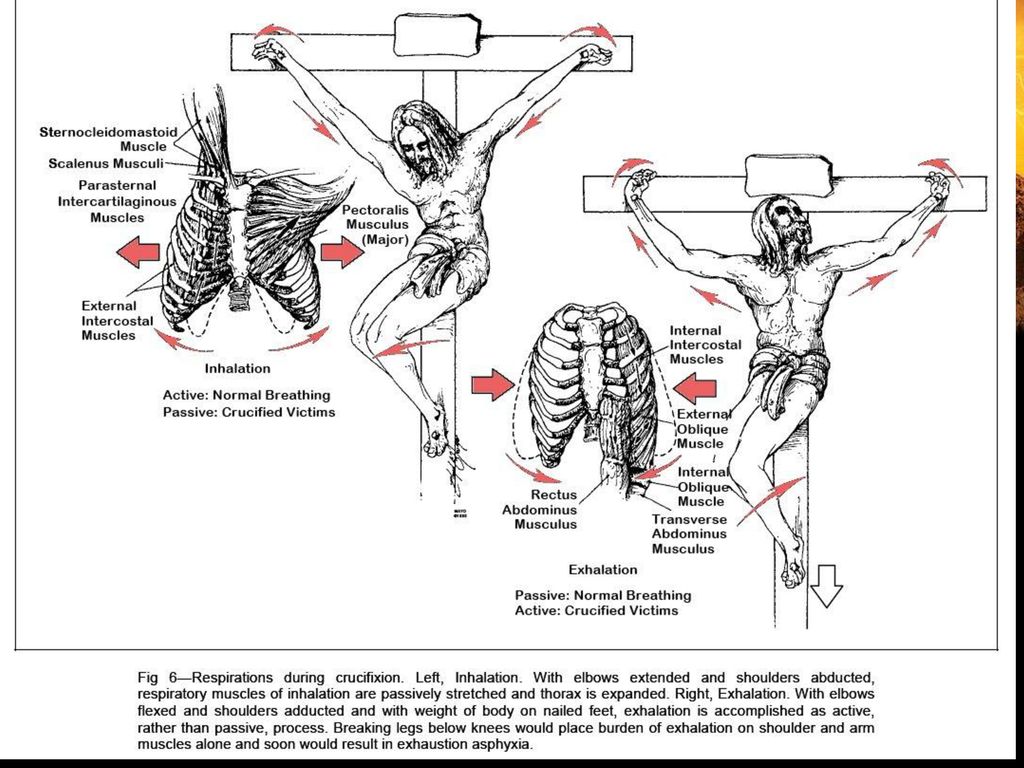
The pain of the cross is like none other. Quite literally, its the source of the word excruciating. For a pain to be excruciatingly painful, is for it to be a pain of the cross. And a lot of this pain comes from the method of crucifixion. Nails place in your feet, and in the most sensitive place in your wrist, in a way that makes it so that you can’t breathe unless you push up on these nail wounds with the weight you your whole entire body. And that’s just to breathe. Imagine trying to speak.
and yet He spoke – seven times He spoke. Seven excruciatingly painful times He spoke. And each time, He suffered to do so. These words, all gospel by the way, were words that came to their hearers (you included as you now read them) through the suffering of Christ literally.
and how fitting is that?
That just as the gospel itself comes to you through His suffering, so also these literal words He speaks on the cross to you come through His suffering,.
His grace for you comes to you through His pain
His love for you comes to you through His pain
His forgiveness for you comes to you through His pain
The Gospel of Christ our King comes to you through His pain
And these words can be categorized in this way;
The first Word: Father, forgive them; for they know not what they do
An amazing thing, our Jesus speaks out of His pain and out of His misery in this moment of divine grace. The very first thing He says to those who crucified Him through the pain of His crucifixion is a Word of forgiveness. Father, forgive them. Forgive those people who crucified me. Forgive those people who hurt me, who harmed me. Forgive those people who kill me. And speaking this Word of forgiveness through the pain of His crucifixion, an even greater grace is this – that He then goes through with that crucifixion down unto death, where He accomplishes that forgiveness for those who crucified Him, by being crucified by them. And this is the radical paradox of forgiveness through death, and even of Jesus drawing all men when He is lifted up. That just as to draw all men (through His crucifixion and death) He must be rejected. And just so also, in order to accomplish forgiveness for those who crucify and kill our Lord by the cross, He must be crucified and killed by the cross. So indeed it is, that His first Word in this action of forgiveness through suffering, pain, and death, is a word of forgiveness. Father – forgive them. And yet how often is it that we see the cross of Christ or gather to meditate upon it during Lent or Holy Week or even Good Friday itself and find ourselves drifting away from Christ’s own work of forgiveness, and Christ’s own Words of forgiveness, and see only our guilt and our shame, on top of Christ’s death, as the cause of Christ’s death, and even reigning over Christ’s death? Let us fix our eyes and focus upon Christ’s cross and your ears upon Christ’s words. For in these words and in this cross you have forgiveness. Culpability or lack thereof aside, whether you know what you do, or do not. Here all sins find their forgiveness. In Christ’s Words, in Christ’s Work, in Christ’s cross.
The second Word: Very truly I say to you, this day you shall be with me in paradise
“But what about the thief on the cross,” is probably the most famous line spoken against the grace given in Baptism or the Christian life lived in virtue and charity and faithful church attendance. “But the cross did none of those things, and yet Christ still promised Him paradise.” And indeed, that’s the point of this 2nd Word. That lest we think that any are excluded from the first because they knew what they did, we are met with the sheer and utter forgiveness of the thief on the cross. Not Baptized (as nobody was, because Baptism wasn’t instituted), not a church goer (because nobody was until after Pentecost), not living the “good life,” so on so forth. Some of these arguments make sense and some don’t but the overall thrust of the sentiment is overwhelmingly true. Whatever this thief was, he was not what he should have been. He most certainly knew stealing was wrong, and did it anyway. Although, by the fact that he is being crucified publicly, we can infer that he probably did a lil’ something more than just steal some flatscreen TVs. This is a bad dude. That’s the point. Yet He sees Christ, and for some reason, perhaps because He’s heard of this Jesus before, perhaps it was a miracle of immediate grace and divine relevation, perhaps its becuase he heard the unbeliever’s mockeries as sermons, or perhaps it was just the evocative visual gospel proclamation of the Christ Himself on the cross itself, but whatever it was, the thief of the cross was moved to faith in Christ, not only as the Messiah – but as his hope and salvation, in the face of death, and even beyond death. That TTOTC was promised paradise in the right now WITH Christ (Messiah/King/God) is to say that the forgiveness of the first Word is offered and given to all, and that it comes with no strings, with no fine print, and with no qualifications. Christ’s forgiveness is not an insurance policy looking for ways out of saving you. But it is spoken at the cost of suffering, and accomplished at the cost of suffering. That is how much God wanted to save you.
The third Word: Woman, behold your son! (and He said to the disciple) Behold your mother!
Beyond having a care for His mother’s physical needs, and staying out of the weeds of speculative Mariology, this word speaks to us of the oneness of Christ’s church. And here rings true Jesus’ statement earlier in His ministry, wherein He says “and who are my mother and brothers? those who do the will of the one who sent me.” Loyalty to family, in some cultures is big thing. And, it is a Christian principle too. For whoever does not take care of their own family, the Scriptures say, has abandoned the faith and is worse than unbeliever. But how much more true is this in the body of Christ? Our fellow Christians and believers are made, in Christ, our true spiritual family. For this reason, though we know what disciple Jesus was speaking to in the literal sense (John), He really says this to all of us. Take care of one another. Love one another as I have loved you. Lay your life down for one another. Feed one another, cloth one another. Spend time with one another. Make time to spend with one another. Treat your church members like what they are, your family. Not strangers, not acquaintances. But brothers, and sisters, and fathers, and mothers, and sons, and daughters. And the saints, your ancestors, your forefathers. And Mary… well, Behold, your mother.
The fourth Word: My God, my God, why have You forsaken Me?
to my own surprise, this past week due to my preaching schedule and podcasting on the lectionary texts, I have been forced into speaking of this cry of dereliction more than I have in the rest of my entire life, due to the controversy surrounding it. To say a little more about it (the same thing, just again), these are not words that Jesus does not mean. We should not come in here to these words with a bulldozer named “Theology Proper” and start talking for 45 minutes about how the Father cannot forsake the Son because X, and Y, and Z. Rather listen to Him, what does He say? He says God has forsaken Him and He doesn’t know why. And? Is He actually asking “Why, please tell me what I did to deserve this?” No. Jesus knows what’s going on. But He quotes this Psalm on the cross, a Psalm He was deeply acquainted with, because it’s in these times of suffering when we cry out to God in these moments of forsakenness. Did “the Father turn His face away?” In an anthropomorphic way, yes. And Jesus felt that anthropomorphism, because He is the Theanthropic Christ. This moment is the moment that He gives Himself to the real suffering of the cross, the shame of sin and guilt. The real pain of the cross, that is more excrucication (literally; more of the cross) than the physical pain of the cross itself, is the Father “forsaking us” (condemning us, accusing us/etc) for our sin. And at this moment, Jesus feels it all. All those feelings, of every single person, all at one time. Most people can think of even a single recent memory of a sin they consciously did, and the gross and almost crushing feeling of guilt and shame that they can’t scrape away. And that’s only of one sin, at one time. Can you imagine every sin you’ve ever done at the same time coming down upon you? Can you think of every single persons sins coming down upon you at one single time? That’s not only the sins of normal people. That’s the sins of real criminals. That’s the sins of the hitlers and marqui de sade’s of this world. That’s the sins of devil worshippers and child-sacrificers. That’s the sin of unbelief and the sin of apostasy. And all the guilt of those sins, and all the shame of those sins, they pained Christ’s soul, and afflicted Christ’s soul, and they tore at His soul – and so in pain, not of the cross, not of suffocation, not of His wounds but of our sins – He cried out. My God, my God – I feel it all.
The fifth Word: I thirst.
Saving the whole world through one’s own suffering and death is thirsty work. And of course, this takes place in order to fulfill prophecies in Scripture. Yet moreso we see that in His thirsting, we are fed the waters of refreshment nad life. For as He dies to give us life. And as He takes our sins to give us the righteousness of God. So also He thirsts, that our dry mouths might be quenched of their thirst by His blood. And as He thirsts, He goes lower even still and is fed sour wine, aka vinegar. Yes, vinegar to a man that had almost 400 open wounds allover His body, on a sponge, soaked and wet, and dripping, held up to His face. Dripping into the wounds in His flesh, as He drinks of this vinegar, to quench His thirst, a thirst not really for water, but for you. For no amount of water in this moment would satisfy your saviour. For His desire, His thirst, was to quench yours, with the blood and water that flowed from out of His heart as it was pierced for you.
the sixth Word: It is finished.
These words of Gospel promise assure us that the cross is not the launch point of our holiness journey, but the end of everything. Sometimes I like to remind those Easter theologians that Jesus seems to have not read their books, because even before He’s in the tomb, He pronounces the whole thing finished. And yet they say otherwise. “What is finished? Maybe just the cross is finished, maybe the suffering is finished, but it’s not really finished.” Ah – but blessed irony this is the truth. It’s not finished and yet it is. Fr as He goes to the cross, He says, I am making all things new. And this He does but ending all things that were. What is not yet, cannot be in progress before it begins. But what is, here at this cross – that is death, and the reign of Satan, and your sin, and the ways of the world, and the kingdom of darkness… yeah, all that is finished. Because here in the death of Christ, the victory has been won – and the thing that was coming – was about to begin.
The Seventh Word: Father, into your hands I commend my spirit
Famous words, prayed every night in the churches bedtime prayers. Some Christians have prayed this every day for over 80 years. And I’m sure that they’re still plumbing the depths of its richness. But in one word, for the sake of drawing out the gospel sense of this last word, let me democratize this for you, as the church has already done in our nighttime liturgy. Death itself is the end. I don’t mean that in the atheistic or materialistic sense. But i mean that in the sense of it being the end of possibility, the end of hypothetically, and the end of what might have been. In death there is no “maybe I wills” and there is no “I will do this.” Death is a complete handing over of one’s agency. And so as we pray these words every night we hand ourselves over to the security of God’s hand, trusting Him in faith, knowing especially that we have no control over what happens as we sleep – and relly and truly if you pray this enough through the day maybe you will catch on to the fact that you have no control over anything. But in praying this we commend ourselves n faith to the providential fatherly GOODNESS of our sovereign God. And yet the crazy thing, to un-democratize this again and to christify it, if you will, is that in His humiliation and “going low” for us (for you), what Christ did was He, who was God, whowas never outside the bounds of agency or possibility or hypotheticality, surrendered Himself fully again, as He had been doing His whole ministry, in the incarnation, in His infancy and childhood, in His youth, in His bodily infirmities, in the limitations of His humanity, in the garden of gethsemane, and finally even in His death.
All these words come to us through His pain. All these words come to us through His suffering. All these words come to us from the cross, and through the cross. Because all of these words are gospel.
Read these words one last time now. And meditate upon these words before you go your own way.
And as you do so, remember that as He speaks each of these words to you, in order to do so, He lifts Himself up by the nails in His hand and feet, pressing against His nerves, His bones, and His raw flesh – just so that He can speak these words of grace, and forgiveness and love to you.
Oh, how He has suffered to save us.


