
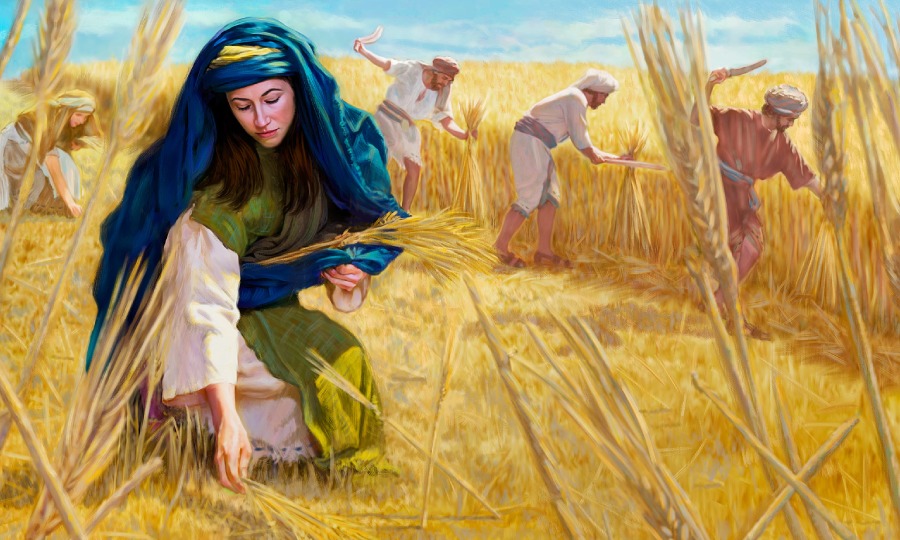
The book of Ruth is about hope in hopeless situations, it’s about faithfulness to vocation, it is about going beyond covenant obligations to show unsolicited mercy and grace, Hesed.Naomi urged Ruth to go back to her gods and her family. Instead, seeing that her covenant obligations were fulfilled to her husband sought to show Hesed towards her mother-in-law who now had nobody but herself. Though back home she had a full loving family and many potential suitors, she decided to honor her husband, Mahlon, and show Hesed to his mother for the sake of her love for him and for her. She showed He4sed in that she worked faithfully in the fields to feed her aged mother-in-law. She showed Hesed to her husband in that she didn’t go after one of the male suitors in Bethlehem, be they rich or poor. Instead, while staying with and caring for Naomi, she waited upon the Lord, in the hope of a kinsman redeemer to honor her dead husband who she had no obligations to (4:10). She showed Hessed, in that looking upon an old man who had no wife and little to no chance of ever having one she proposed to him that he take her, a young woman, giving him the chance to raise a family and to have the joy of a wife and children in turn that her husbands land and future line may be redeemed. God blessed this Hesed by using this line of seed to show Hesed to all creation, through the birth of the Christ, the ground and basis of all Hesed.This is reversal theology at its finest. Ruth sought redemption through hope in a hopeless situation, looking not at the situation but on the promises of God, a family of widows became a family of kings, a family of THE King. The most unfathomable portion is when she, though free of all obligations, makes a vow unto God to stay and care for Naomi, against a punishment most severe and says “your God will be my God” (1:16). Nothing but a living faith could make a woman separated from her home, family, culture, and religion in the face of a hopeless situation with the freedom to choose whatever she wanted to choose further commit to the state of hopelessness but a faith in that God that was now hers. Faith in the God who redeems. In making this vow before God to Naomi she wasn’t just vowing to be responsible for Naomi. She was covenanting herself as an individual free of her Jewish head to receive all that she will from the Lord’s hand, be it good or “evil” as Job says (2:10). To stay with Naomi for Ruth was to stay with God. and no matter the cost, be it widowhood in youth, daily toil in the fields fit for the homeless and the impoverished, or a lonely death after the passing of Naomi, she was determined to be wholly unto God, particularly in the hope that might redeem her husband’s land and seed. She refused to marry another Jew in Bethlehem. She could still have cared for Naomi and be under God all the while having her various needs met, building a family and living in wordly comfort. But she, having encountered the God of Hessed was set against the standard of meeting obligations, she was going to reflect her heavenly Father and be a woman of Hessed. She wanted to give to other people the thing that transformed her life. To do this, she forsook the world, and her future, she walked down a dark path that seemingly led nowhere, in the faith that one who surrenders all and empties themselves in order to lay hold onto God’s promises already has the fullness of all things. “For to everyone who has, more will be given, and he will have abundance” (Matt 25:29). Naomi promised Ruth rest in another husband, one of the Moabites from where she came. But Ruth knew that her Rest was forever in the Lord. This idea, this one of hope in hopeless situations is one where she sees what’s around her, and she looks not at what she sees but she looks at what she knows is promised in God, true Rest, Hessed, mercy. Walking into nothing, knowing that in God she had everything, she came out on the other end with an abundance of blessings. Where Naomi complained, “I left full and came back empty”, Ruth emptied herself of all worldly comfort, security, and hope, knowing that in the Lord she had the fullness of everything, and from this emptying, she gained fullness. Just as Christ, coming to us, from glory, emptied Himself of His glory, to show us Hessed. He walked into the nothing to give us everything and in result, “was declared to be the Son of God in power according to the spirit of holiness by the resurrection from the dead” (Rom 1:4). And we through faith in Christ are proclaimed to be sons of God (Gal 3:26), glorified with the glory that the Father gave to the Son (John 17:22). Ruth died to self, and in doing so became alive to God in Christ (Rom 6:11). Don’t say to me, Ruth is a proverbial narrative about loving your elderly family members or an example of how to be a good person, don’t you dare say that to me. Don’t say to me that Ruth is a historical necessity to show an unbroken genealogy through history. Don’t even think about speaking those words to me. Ruth is the gospel of reversal, Ruth is the Magnificat, Ruth is the death and resurrection, Ruth is the Song of Hannah, Ruth is the parable of the pharisee and the tax collector. Ruth is faith. Ruth is the 4th commandment. She remembered the Sabbath day. will you, when times get tough when your luck runs dry, look to your treasure in heaven? Are you, who are full, willing to empty yourself and go out, that you might become full in abundance? Are you willing to sacrifice your son, Isaac, to father many nations more numerous than the stars? Are you willing to abandon your princehood over a people of slaves to free them and become a prince of the free? Are you willing to abandon your own throne, to live in exile in order that your kingdom may have no end? Are you willing to abandon your godhood to suffer and die for those who hate you that you might raise them up to a place of glory? No, because you aren’t Christ. But it is Christ who says to you, come and die, that you may have life (10:39), and drink of it fully (John 6:55-59). Being full, empty yourself, go out empty that you might be brought back full. Forsake the world that you might gain the universe as your inheritance. “Surely we are named after Christ, not because he is absent from us, but because he dwells in us, that is because we believe in him and are Christs one to another and do to our neighbors as Christ does to us.” – Martin Luther The Freedom of the Christian


