
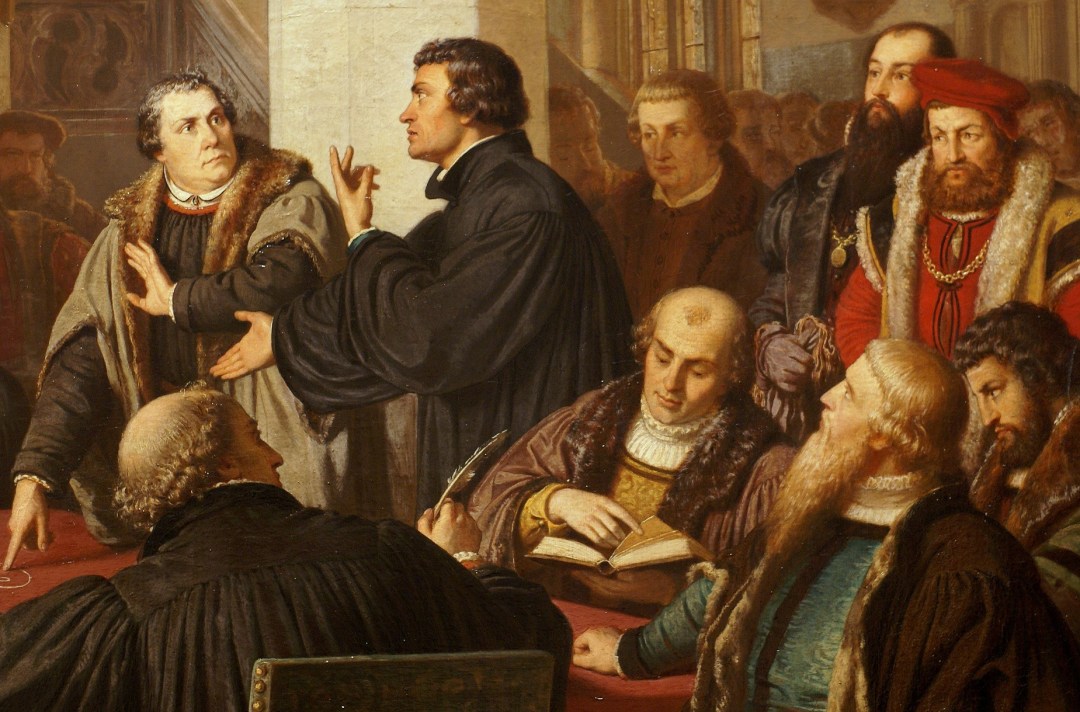
All of this then begs the question of what place tradition has in theology. If the task is to hear and put forth God’s Word, then what do we make of the churches theological writings? In short, these are to serve as witnesses to the clarity of Scripture. The breadth of these texts speak to us in consensus to bear witnesses to the clarity of Scripture as preached and put forth in agreement. Thus, while we put forth the doctrine of Scripture alone as the source of doctrine, Scripture is never to be read alone. But in community with the whole church, lest our own personal biases or failings blur our vision of the truths handed over. This method can be seen in the Formula of Concord Epitome 1:1-2, 8 where a sharp distinction is made between the Divinely inspired Scriptures and the theological witness of the church. The first is source and the second is witness. This principle is seen quite clearly in the negative sense with Luther when he says of Zwingli that his theology is not in accordance with that Word, or, conversely with Melanchthon’s positive use of the church fathers in his Augsburg Confession.1
As such, the writings of the church are to be used in a positive way, bearing witness to the clarity of Scripture where and when they speak in consensus. Yet of those writings which speak their own words, or break from this consensus, we are to deem not as theology but as anthropology. Not the Word of God but the word of man.
As for polemics then, something which Luther was much too fond of, we approach the question by first judging according to the Scripture and to the witness of tradition to weigh its congruity. If the work is found true, we bring it into our voicing of church theology. Yet if it is found false, it need not be argued against, but left silent. For what God has not spoken we ought not speak. The role of polemics in theology then is to be silence regarding error, and application regarding the truth. We needn’t condemn heresy as it condemns itself.1 When God speaks He speaks absolution, when we speak of Him in His hiddenness we speak only terror. Thus, heresy becomes its own terror, and the denial of hope its own hopelessness. As for how to help those in heresy to come to orthodoxy is a matter not of reason, as we confess, “I believe that I cannot by my own reason or strength believe.2 As such, by reason the heretic will not be convinced. It is only by the revelation of truth that one is given the faith to believe it. Again as we confess of this, “but the Holy Ghost has called me through the gospel, enlightened me by his gifts, and sanctified and preserved me in the true faith.”3Thus, to the heretic, we speak only truth and give no more voice to their unbelief than they have done themselves.
1 LW AE 37, Page 367.
2 Henry Eyster Jacobs, ed., The Book of Concord; Or, The Symbolical Books of the Evangelical Lutheran Church (Philadelphia: General Council Publication Board, 1916), 367.
3 Ibid.
polemics cannot be theology because we canot say what God does not say. Furthermore, the “binding key” so called is not a positive use of force but the absence of the loosing key. For when God speaks He speaks absolution. Thus, to those who say women can be ordained contrary to the scriptures we needn’t speak words of condemnation against them, as their own words lock them out and away from the office of the Holy Ministry and God’s sacramental absolution. We needn’t speak a word of condemnation to those who deny baptism saving becuase they themselves have done it to themselves already. Here we cite SC office of the keys, to those who do not beleive we withhold absolution, we add nothing. For they have already condemned themselves (John 3:18). And here also Luther is a help on those who deny the Eucbarist in confession on the Lords Supper, they have merely bread, wine, and no forgiveness Thus, we needn’t condemn heresy as it condemns itself. When God speaks He speaks absolution; when we speak of Him in His hiddenness we speak only terror .
Thus, to the heretic, we speak only truth (though this does not mean only Gospel). Of those who say women can be ordained, we state the scripture: they cannot and we say no more than God has said. To those who say the eucharist is not what God says, we state what God says, that it is. Their own rejection of this is the condemnation. In saying nothing more, we exercise the force of withholding.
As for how to help those in heresy to come to orthodoxy is a matter not of reason, as we confess, “I believe that I cannot by my own reason or strength believe.1 As such, by reason, the heretic will not be convinced. It is only by the revelation of truth that one is given the faith to believe it. Again, as we confess of this, “but the Holy Ghost has called me through the gospel, enlightened me by his gifts, and sanctified and preserved me in the true faith.”2Thus, to the heretic, we speak only truth and give no more voice to their unbelief than they have done themselves.
1 Henry Eyster Jacobs, ed., The Book of Concord; Or, The Symbolical Books of the Evangelical Lutheran Church (Philadelphia: General Council Publication Board, 1916), 367.
2 Ibid.
Objections
In objection to this some have doubted whether it is possible to judge theologies as definitively true or false based upon Scripture and the consensus of the church’s reading of them, either due to an unbelief in their clarity, or to a fear of confirmation bias. In answer to this it must be stated that if this is the case, then neither can statements of the unclarity of Scripture or of confirmation bias be made, as nothing definitive can be stated of the unclear and hidden, nor could one be certain that such a statement would not itself merely be confirmation bias. Thus, those who speak this way are forced by their admission of blindness to speak only for themselves, as they themselves do not trust their ability to understand the words of others. To those who believe this, we state the Scriptures testimony back again, to which their denial will show who it is that is coloring over God’s Word with their own opinions, letting the text alone speak and judge for us.
Lastly it would stand from many that this strikes them as being uncritical and that the text of Scripture cannot mean what it says, since that which Scripture says has been made untenable through scientific exploration. They put this idea forth in several ways. First, that certain things attested to by the Scripture simply did not happen, or were misunderstood in ways that we now understand correctly through science, such as miracles, demonic possession, the resurrection, the innerrancy of Scripture or divine inspiration itself. Yet it is also argued on the grounds that the veracity and authenticity of the Scriptures has been shown by anther kind of science, that being textual or form criticism to be, as it were, again, untenable. Here it is reason at work in judging divine revelation. While these arguments are worth considering, they are by definition not divine, nor do they claim to be. They are not theology but anthropology. Those who do not believe in God, or in His Word or action, by their own admission, are on the outside of this discussion. We ought merely to consent to their will to be so.
This applies applies to more conservative forms of Christianity such as baptists or the Reformed who say that judged by other philosophical axioms of reason, certain texts cannot mean what they say, such as holding up “finitum non capax infniit” against the ubiquity of Christ, the presence of His flesh and blood on the Altar, and the communication of the attributes. So also others will place their reason between two Scriptures, such that baptism cannot save because faith alone saves, therefore demanding reinterpretation of the clear words. Again, this is found not to be God’s Word, but man’s unbelief in God’s Word alone and nothing more.
Conclusion
In conclusion, the question of method in theology must be bound to its definition. As Theology is the Word of God heard and spoken, this theology must find its root and source in that Word. Where it does not, it is not theology in any real sense. The skeptical theologies of our day are less theology and more exercises in unbelief. The thoroughly reasoned exercises in scholastic speculation are merely man’s groping in the darkness of his own imagination. Only a theology that is God speaking His Word can give what man lacks. Only God’s Word and our amen can form a true theology as such.
1 LW, Vol 37, 179.


