
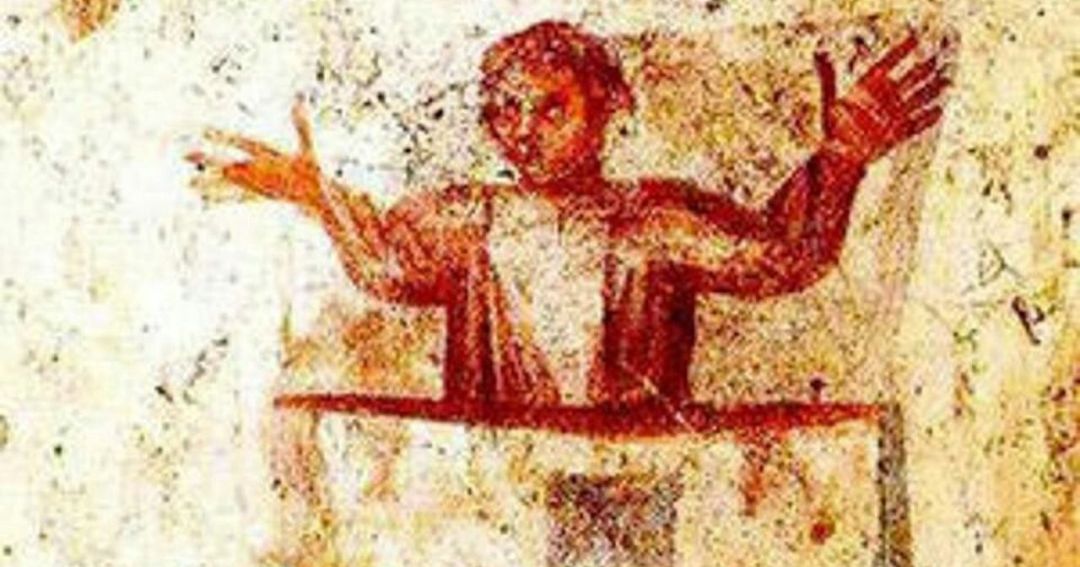
The Liturgical tradition of the early church, while developing well into the Post-Nicene era of church history has roots that predate Pentecost itself. Before the uniquely Christian sacraments of Baptism, confession, confirmation, holy unction, and the Eucharist were instituted by the Lord Christ and passed down by the Apostles, the types and prefigurements of these things, together with the liturgical structure of the prayers of the church were already laid down by our Lord God in the Old Testament and developed according to organic arrangement by His people in their time of exile. At the time of Pentecost the form of Jewish worship came in a set two. The temple liturgy with the Old Testament priesthood, the vestments, the incense, and the sacrifices was the first, coming from direct command of the Lord. These sacrifices were made together with prayers and praise. The second was that of the synagogue, which developed organically in the time of the Jewish exile in Babylon, in which they would gather together first with a benediction, declaration of the law, litanies, Psalms, and the reading and preaching of the Holy Scriptures. From this developed also the hours of Jewish prayer, still practiced by the Jews today. It is in these two things of Jewish worship that the worship of the Christian Church finds its root, developing respectively into the liturgy of the Word and the liturgy of the Altar.
While it is clear that after the institution of the Christian Sacraments that these were celebrated apart from the Jewish synagogue, in exclusively Christian meetings, as we see in the New Testament accounts, it is also clear in the same texts of Scripture that the Apostles and the Christians living in the 1st century continued synagogue attendance at the same time. Yet even so, it was in these exclusive Christian meetings that occurred during the time of Christian inclusion in synagogal worship that the Christian meetings began to take on the form of these Jewish liturgies, importing into them things that were already being done in the synagogues. Yet, as the separation between the Christian church and the synagogue grew, especially in conjunction with the gentile inclusion into the church, the snyagogification of Christian worship began to increase, to become a full replacement for those who had been kicked out of the synagogues for good.
The first examples of early Christian worship that we see are in the New Testament Scriptures themselves. Beginning with our Lord’s own institutions, we have the uniquely Christian sacraments of Baptism, instituted in Matthew 28:19, which was commanded to be done with immersion in water in the name of the Father, Son, and Holy Spirit, Confession and absolution in John 20:23 and James 5:16, where we see also the sacrament of Holy Unction, and the Eucharist in Matthew 26:26-28. These sacraments formed the basis of Christian worship, in especially in its distinction from Jewish worship. Yet the similarities between the worship of the Jews that took place in the synagogue and that of the Christian assemblies is seen here also, in the signing of Psalms (Col 3:16, Eph 5:19, and Jas 5:13), the prayers (Acts 2:48), and the reading and preaching of the Holy Scriptures (1 Tim 4:13). It was from these things, the basic structure of the synagogal worship, together with the unique sacramental institutions of Christ, done on the 1st day of the week (Acts 20:7, 1 Cor 16:2), that the Christian liturgy developed.
As we leave the Scriptures, we find that it is these uniquely Christian rites that find themselves to be emphasized. Beginning with what is quite possibly the oldest-extra biblical document of the church, the Didache, we already see this taking shape, with the same uniquely Christian rites being fleshed out in the form of specific liturgical church orders for their celebration and administration. The first of these that we see mentioned is the Sacrament of Baptism. Here, the Didache states not just that Baptism is to be done by immersion in water in the Triune name, but that qualifications, exceptions, and specific instructions have been amended thereto.1 Here, we find exceptions and exemptions to the rule of immersion, together with the instruction to immerse thrice as the names of Father, Son, and Holy Spirit, are spoken, and with the added instruction of fasting preceding it. The same is true here also in regard to the rest of the liturgical elements in the Didache. With fasting, specific days are given, namely Wednesday and Friday to distinguish their fasting from that of the Jews.2 With the Lord’s Prayer, an amount per day is given, that being 3 times, which fit into line with the 3 times of daily prayer for the Jews.3 Yet, with the Eucharist, we see something far more important and explicit. We see there that already in the writing of the Didache, that a specific Eucharistic prayer of considerable length and form is is instructed both before and after.4 In that same context, and with an eye toward the Eucharist and the right reception of it, the Didache speaks of the need to confess ones sins, so that they may be purified in order to rightly receive this Sacrament and to offer up to the Lord pure sacrifices.5 All of this is said to happen on the first day of the week, that being the day of Our Lord’s resurrection, rather than on the Jewish Sabbath.6
St. Ignatius helps to continue painting our picture of Ante-Nicene liturgics in an indirect way by speaking again not of “the liturgy” as a whole but again of these chief things of the sacramental institutions of Christ, yet here he adds for us two key additional details; being the liturgical furniture of the Altar as something used in Christian worship and by explicitly forbidding liturgical actions that are done apart from the bishop or his consent.7 In that the altar is mentioned as being used, here St. Ignatius adds his common focus on unity. For as he says, those in the church “have but one faith, and one [kind of] preaching, and one Eucharist. For there is one flesh of the Lord Jesus Christ; and His blood which was shed for us is one; one loaf also is broken to all [the communicants], and one cup is distributed among them all: there is but one altar for the whole Church8. Not only do we see here that there are used in this liturgy an altar, a loaf of bread, and a cup of wine, but that theological meaning and reflection has been attached to both the things as well as the actions of the liturgy, beyond the obvious matters of the sacraments themselves. That is to say that already in the time of St. Ignatius, the liturgy was not just being done, but it was being deeply thought about even at the level of liturgical action, furniture, and rubric.
When we arrive at St. Justin Martyr, we see again these same themes and shapes in his own work. Again, liturgically the focus is on the sacraments instituted by Christ. Yet, there are again the beginnings of orders and rubrics attached to it. Such as the mixing of wine with water in the celebration of the Eucharist, the prayers and thanksgivings associated with it, and the kiss of peace which precedes it all.9 Yet one will notice here as well as in the aforementioned places in the other writings of the Holy Fathers, where prayers and thanksgivings are mentioned it is not alone, but in relation to the sacraments. It is not as though the fathers speak of “the prayers in the liturgy,” but rather that they speak of prayers in relation to Baptism, or thanksgivings in relation to the Eucharist. Yet in another way, within Justin Martyrs’ writing we see here a deeper glimpse into the actual happenings within the liturgy. For example, it is said that the cup of wine mixed with water is “brought to the president of the brethren,” and that afterward, a “portion” of the Eucharist is brought to those who were absent.10 In this we see a picture of the moving pieces within the liturgy, both in regard to things as well as people. The bread and wine are being moved around and brought by one up to another. A specific cleric is blessing specific things. People are interacting with one another such as in the kiss of peace. And there is a distinct sequence of events being laid out for us, with the Baptism, the prayers, the readings, the sermon, the kiss of peace, the offertory, the Anaphora, and with mention of congregational responses in the amen.
As time drew on in the church, the rubrics in the liturgy continued to develop further in accordance with this aforementioned direction as the liturgical rubrics began to grow and become more elaborate. While the Didache as previously mentioned refers us to baptism as a thing done by the clergy of the Church by triple immersion in the Triune name and preceded by fasting, we see that here Tertullian adds also mention of a confession of faith and a renunciation of Satan. He says to us in, De Spectaculis, “When entering the water, we make profession of the Christian faith in the words of its rule; we bear public testimony that we have renounced the devil, his pomp, and his angels.”11 It is also Tertullian who tells us that sponsors are used (Of Baptism), that aft wards they are Christmated (Of Baptism), marked with the sign of the cross (Of the Resurrection), and that lastly they are fed milk and honey (The Chaplet).12 Through Cyprian, in Epistle 69, we are told that there is as consecration of the baptismal water that appears to be performed prior to the Baptism which was understood as making the water efficacious in the ministration of this sacrament.13
The sacrament of confession, which Justin Martyr and the Didache both instruct to be done before partaking of the Altar was not done privately, but as Tertullian, Cyprian, and Origen tell us, publicly before the whole church, as an act of disciplinary penitence in which the whole congregation participates in interceding for this person on their behalf.14
Coming to the Holy Eucharist, the only development beyond that which Justin Martyr has given us is St. Cyprian who works to bring our understanding deeper, wherein refers to the Sursum Corda in The Lord’s Prayer, when he writes; “the priest, by way of preface before his prayer, prepares the minds of the brethren by saying, “Lift up your hearts,” that so upon the people’s response, “We lift them up unto the Lord,” he may be reminded that he himself ought to think of nothing but the Lord.”15
From these few examples of the liturgy in the Ante-Nicene Fathers we see that from the very earliest of Christian documents in this era through to those in the latter end, there is a development in the written record into something that more closely resembles that which is spoken of in the Nicene and Post-Nicene era. Yet in all of this, the emphasis is upon Baptism and the Holy Eucharist, with the Eucharistic prayer being one of the things already developed in the earliest documents. Whereas the mentions of the readings, the preaching, and creeds, while not absent from these Fathers, do not take the place of focus. From this we may deduce that the Ante-Nicene liturgy was seen first and foremost through the lens of the Sacramental events rather than as a sequence of propositional or didactic movements, as was the case with the Jewish Liturgy in the synagogue, even though it is clear by implication that these same things were retained.
Cyprian of Carthage, “The Epistles of Cyprian,” in Fathers of the Third Century: Hippolytus, Cyprian, Novatian, Appendix, ed. Alexander Roberts, James Donaldson, and A. Cleveland Coxe, trans. Robert Ernest Wallis, vol. 5, The Ante-Nicene Fathers. Buffalo, NY: Christian Literature Company, 1886.
Cyprian of Carthage, “The Lord’s Prayer,” in Fathers of the Third Century: Hippolytus, Cyprian, Novatian, Appendix, ed. Alexander Roberts, James Donaldson, and A. Cleveland Coxe, trans. Robert Ernest Wallis, vol. 5, The Ante-Nicene Fathers. Buffalo, NY: Christian Literature Company, 1886.
Ignatius of Antioch, “The Epistle of Ignatius to the Philadelphians,” in The Apostolic Fathers with Justin Martyr and Irenaeus, ed. Alexander Roberts, James Donaldson, and A. Cleveland Coxe, vol. 1, The Ante-Nicene Fathers. Buffalo, NY: Christian Literature Company, 1885.
Ignatius of Antioch, “The Epistle of Ignatius to the Ephesians,” in The Apostolic Fathers with Justin Martyr and Irenaeus, ed. Alexander Roberts, James Donaldson, and A. Cleveland Coxe, vol. 1, The Ante-Nicene Fathers. Buffalo, NY: Christian Literature Company, 1885.
Justin Martyr, “The First Apology of Justin,” in The Apostolic Fathers with Justin Martyr and Irenaeus, ed. Alexander Roberts, James Donaldson, and A. Cleveland Coxe, vol. 1, The Ante-Nicene Fathers. Buffalo, NY: Christian Literature Company, 1885, 185-186
Roberts, Alexander., James Donaldson, and A. Cleveland Coxe, eds., “The Lord’s Teaching through the Twelve Apostles to the Nations,” in Fathers of the Third and Fourth Centuries: Lactantius, Venantius, Asterius, Victorinus, Dionysius, Apostolic Teaching and Constitutions, Homily, and Liturgies, vol. 7, The Ante-Nicene Fathers. Buffalo, NY: Christian Literature Company, 1886.
Tertullian, “The Shows, or De Spectaculis,” in Latin Christianity: Its Founder, Tertullian, ed. Alexander Roberts, James Donaldson, and A. Cleveland Coxe, trans. S. Thelwall, vol. 3, The Ante-Nicene Fathers Buffalo, NY: Christian Literature Company, 1885.
Tertullian, “The Chaplet, or De Carona,” in Latin Christianity: Its Founder, Tertullian, ed. Alexander Roberts, James Donaldson, and A. Cleveland Coxe, trans. S. Thelwall, vol. 3, The Ante-Nicene Fathers. Buffalo, NY: Christian Literature Company, 1885.
Tertullian, “Of Baptism,” in Latin Christianity: Its Founder, Tertullian, ed. Alexander Roberts, James Donaldson, and A. Cleveland Coxe, trans. S. Thelwall, vol. 3, The Ante-Nicene Fathers Buffalo, NY: Christian Literature Company, 1885.
Tertullian, “The Resurrection of the Flesh,” in Latin Christianity: Its Founder, Tertullian, ed. Alexander Roberts, James Donaldson, and A. Cleveland Coxe, trans. S. Thelwall, vol. 3, The Ante-Nicene Fathers. Buffalo, NY: Christian Literature Company, 1885.
Warren, F. E., The Liturgy and Ritual of the Ante-Nicene Church. London: Society for Promoting Christian Knowledge, 1897.


