
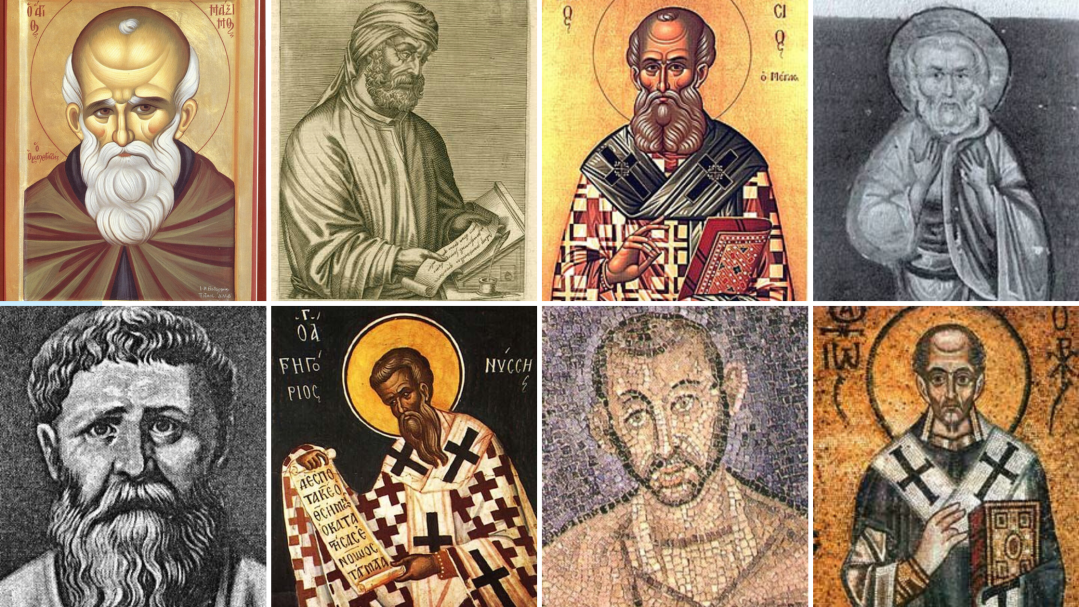
Just as there are, in the theology of the Church, the four marks of holiness, unity, catholicity, and apostolicity, so also there are four marks of qualification for the fathers of the Church. As Payton notes in A Patristic Treasury, these four marks required for designation as a father of the church are antiquity, holiness, orthodoxy, and ecclesiastical approbation.1
The antiquity of the fathers relates to their proximity to the lives and ministry of the Apostles, as well as in regard to their contextualization within times of doctrinal formation and controversy. The periods, as noted by Ramsey in Beginning to Read the Fathers run from the mid-late 1st century all the way to the 8th century.2 In this span of time, which we now deem “antiquity” is found several distinct eras, each less antiquated than that which came before it, yet the latter are just as important for us, in their own distinct ways and for distinct reasons. Yet, each of these eras, while all “antiquity” for us, are worthwhile not only in that they are older than we are, but because they speak to a particularly formative time and context in church history. The importance of antiquity in regard to the apostolic fathers cannot be separated from its connection to the apostles themselves, with some of the authors in this era having known them personally, or been the successor to their successors. Here we find a tangible and personal memory of the apostles and their teachings. In regard to that of the fathers who lived during the councils, or the doctrinal controversies, we see the theological thought being formulated in real time. And in regard to those living through harsh persecutions, we find for ourselves the Martyrial spirit and voice of the church.
The second requirement for qualification of church fathers is holiness. The holiness of the Fathers is the divine life, or the deification of God’s people made manifest. This is seen in the Fathers not only in that they were not living in rank unrepentant sin but far more importantly in their love for Christ and His mystical body the Church. They show this in their zeal for the defense of truth, and for the conversion of those who have yet to accept it, as well as in conformity to the Law of God and the love of Christ. The importance of this mark of the Fathers is intertwined with the third qualification of orthodoxy, in that throughout the Fathers their understanding of theology is as one that is lived and expressed through holiness, toward the purposed end of union with God through Christ Jesus. However, as Ramsey notes, in some ways the holiness of the fathers is not applied in the strictest way possible, as we see in the lives and even in the works of the fathers there are some personal shortfalls and imperfections in character as seen in what he describes as “unwillingness to comprise, self-righteousness, rigidity, manipulativeness, irascibility, and the like.”3 Thus, we see in the fathers not an absolute perfection of character, but an active presence of God within the life, ministry, and writings of real people in the ancient church.
The third qualification of orthodoxy is found in several ways. The first and most obvious is that of the theology that they taught. For one to be a father of the church they must teach the church the doctrines of the church that were handed down by the apostles and the fathers that came before them, and be in accordance with what has been universally confessed by the church through her councils, and the consensus of her life and witness. Yet here Ramsey again “qualifies” these qualifications by reminding us that there are many examples of patristic works that contain things that would not be considered strictly orthodox by today’s standards.4 Yet in many cases these are given leeway due to their temporal precedence before councils which sorted disputed matters, or in other cases, these writers are held a little less tightly than others. Two examples that he notes are Tertullian and Origen, both overwhelmingly famous writers from the patristic period, both of great influence in several areas of the church’s theology, and yet both fall short of the strict definition of theological orthodoxy. In the case of Tertullian, and many others, we find the idea that the Son and Spirit are subordinate to the Father. In Origen we find a universalism of the highest degree. Those fathers that we deem “saints” and those we utilize most are those who stick closely to the orthodoxy of the church’s teaching.
The last of the qualifying marks of the Fathers of the church is that of the church’s approval of said individual and her reception of them as a Father of the Church. This is seen not only in her deeming them “saints” of the Church and Fathers of the church but also in her use of them throughout the ages, and the lack of qualifications upon her use of them, as well as a lack of warnings attached to her use of them.
There is great importance in these marks when they are found all together in an individual. Not only because one or two of these alone would be insufficient, but in fact because these marks are causally intertwined with one another. As holiness comes from orthodoxy, and holiness leads to orthodoxy, and both are necessary for the approbation of the Church. Only one of these things can be had without the others, namely antiquity. Yet antiquity without orthodoxy, is heresy. And heresy leads one neither to holiness, nor to acceptance into or by the church.
Thus, it may be said that the Fathers of the Church, in other to be Fathers of the Church, must themselves bear the marks of the Church within themselves as individuals. They must themselves maintain unity with the church, in membership therein, in doctrine and in practice. They must be holy in their lives, and devoted to the Lord in love. They must hold the wholeness of the faith in their confession and teaching of the faith. And they must maintain the apostolic authority in witness. Only when all of these things are found within their person will the church consider them a Father of the Church.
1 James R. Payton Jr., A Patristic Treasury: Early Church Wisdom for Today, (Chesterton, IN:
Ancient Faith Publishing, 2013), pp, 15.
2 Boniface Ramsey, Beginning to Read the Fathers, (Mahwah, NJ: Paulist Press, 1985), p. 4.
3 Ibid, 5
4 Ibid, 5-6


