
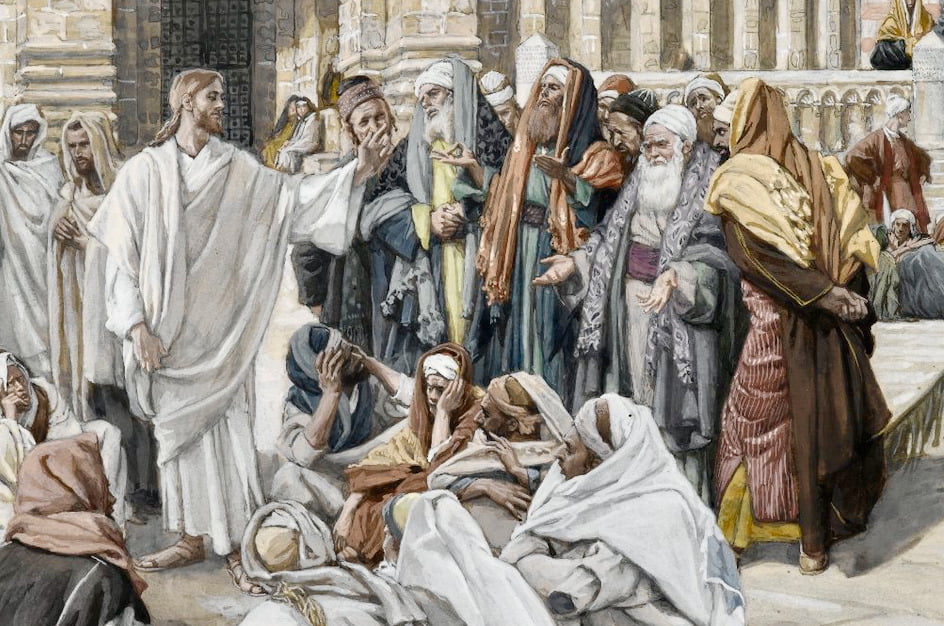
This past Sunday in our readings we had the texts of Exodus 20 and Psalm 19. The Law of God. The 10 commandments. And every year, more or less, in the Lutheran church, we are encouraged to preach on those commandments, along with all of the rest of our Small Catechism and the faith it contains. But —— last Sunday you may remember that we also had St. Paul’s Words which reminded us, and adjured us to be a people who did not seek for the teaching of wisdom, or to be fixated upon signs and miracles and wonders but who proclaimed the singular message of Jesus Christ and Him crucified. And so I preached to you about that message. About the cross which is foolishness. And of it’s being the center and crux of our Christian identity.
And so I thought instead perhaps TODAY I might preach to you of the Law, as we have the Law in our lectionary today again. Yet – here also, while we find a call to the importance of the Law of God in Dueteronony, we see also all the more our Lord teaching on His greater importance in regard to the Law. And so again we are faced with this truth, (and it is a Lenten truth) that Christ has not come to teach us lessons of virtue but to be virtue itself. He has not come to show us the way to righteousness, but to grant His righteousness to us as free gift. He has not come to teach us how to save ourselves, but He has come to save us Himself.
And so today I want to preach to you about the Law and about Jesus, and how they relate to one another. I want to preach against 3 errors, three heresies. One old, one ancient, and one eternal. And then I want to press upon you, the TRUTH that we proclaim as the Gospel of Jesus Christ. We begin with the Law itself.
You see, we look at the Law. We look at the 10 commandments. The teachings and instructions of our Lord. Have no other Gods, Don’t take the Lord’s name in vain, Remember the day of rest, Honor your Father and Mother, Don’t kill, don’t commit adultery, don’t steal, Don’t lie, Don’t covet. And there in these words we see goodness itself. We see, even before this, in Exodus 20, the good news that God is our God, that He has created us and cared for us, preserved us, and sustained us, and that He is our redeemer, who has taken His people out of their slavery in Egypt, and freed them into the place of His promised rest. Here, in the Law of God, we see God’s proclamation that He is the God that created us, that saved us, and that sanctified us – and then we see Him call us to live into that reality. And to be holy as He is holy. To reflect His image and His goodness as it is within Himself, and as it has made a home within our hearts. That is, really, in essence, what the Law of Exodus 20 IS.
And we think, man, well, I LIKE THIS. These laws these commands, these teachings – these are good. Why would we want to replace these? Why would we want to get rid of these? These things, these are the most basic most foundational bedrock of goodness and virtue in religious life. Surely it couldn’t be that Jesus had come along to GET RID OF goodness and virtue and love. Right?
RIGHT. And that’s His point here. See while many in this world, particularly of those in certain “churches” in this world (which I won’t here name), DO INDEED TEACH that Jesus came to abolish the law. And that Christians needn’t be concerned with “THE OLD” testament, or its laws, or its teachings, or its shape – Jesus Himself said in fact that HE DID NOT COME to abolish it. In fact He said furthermore that until heaven and earth pass away, not even the smallest letter or the smallest part of a letter will pass from the law. And so the Law remains. The goodness remains. The righteousness and the virtue remains.
And so we see the first error regarding Jesus and the Law. That because Jesus came there is no Law. That since Jesus came, the “OLD” testament, has become irrelevant to His church. This is entirely false. It could be no further from the truth. The law endures. The law, and its goodness and righteousness, and the love it speaks of, will endure beyond the heavens and the earth. Because the Law, as part of God’s Word, will endure forever though the grass wither and the flower fade. And so this is the first error. To think that the Law has passed away and is no more. This is an old old heresy in the Church, which the church calls “anti-nomianism,” meaning those who are against the law.
And yet there is a second error here. To think that because the Law DOES endure that the law is done in us and through us and by us, apart form God. And how great a danger this is – to rightly identify this fact and this truth; that in the Law we see that which is good, and true, and beautiful,, but to then wrongly think that these things are done and found to their fullness in us. Believing that we ourselves are the doers, the sources, the bringers of goodness, and truth, and beauty. If we do so, we will end up coming to the Lord like the rich young ruler proclaiming that in regard to the Law of God, we have done it all, – when in truth, we have neither believed in God nor loved Him fully.
This danger, the Holy Scriptures names the sin of pride. Seeing the Law of God (which we do not do), and wrongly believing that we have done it all perfectly, fulfilled it, and embodied it rightly. Yet, it is an easy error to fall into. Isn’t it?
You see, we see these words of deuteronomy that we must do this law and abide by this law and fulfill this Law if we wish to enter into the promise of God. And we see these words form Our Lords own mouth that whoever breaks any these commandments or permits others to do so will be called least, but whoever does them and teaches them will be called the greatest – and we fall one of three ways. Either we fall by claiming that this Law no loner exists, like the cursed individuals who negligently break God’s Law, and teach and permit others to do so because they believe it no loner exists nor matters. Or we fall like the pharisee in the parable with the tax collector, or like the rich young ruler, by falling into pride, thinking that we actually HAVE done this Law, and fulfilled it to the full and accomplished salvation through it earning for ourselves a goodness and a truth and a beauty and a salvation by our own efforts. This the church calls the sin of pride. And those who indulge it, are named as an even more ancient heresy, which the church calls “pelangianism,” those who believe that they can save themselves apart from God or His grace. These are those who, seeing that our Lord says that in order to enter into the kingdom of heaven, they must have a righteousness EVEN GREATER than the Scribes and the Pharisees and the expert practitioners of the Law, and say – oh yeah that’s no problem I’m already the best. This is the sin of pride, – this is the heresy of pelagianism. To believe that you don’t need God’s grace, forgiveness, help, or salvation. Only instructions.
And so now you have heard warnings against two errors. Two heresies; one old, and one ancient. You have heard that the Law endures and has not gone away. That you in fact, need to do it. That you must hear it and embody it. That its fulfillment is necessary. Yet you have also heard that you yourself cannot do it. And so this brings us to the third error. That of despair. That which believes that I must be good and righteous and perfect, but that I can’t and so I’m inevitably doomed.
Now, let’s test ourselves with a pop quiz to see how well we understand the Gospel of Jesus Christ. – WHAT IS THIS ERROR IGNORING? What is it forgetting? What is it denying? – the grace of God. The forgiveness of sins. And the gift of the very righteousness of God given freely through Christ by Word and Sacrament.
You see the key here is this, it is true that the Law endures. It is true that the Law must be done. It is true that you cannot fulfill it but what else did you hear in the reading of the Holy Gospel this evening? – THAT CHRIST has fulfilled it for you. And this is the greatest truth of all. See, all that you see in the Law, its goodness, its truth, its beauty, its love, its virtue, it is not above Christ, it is not equal to Christ, but is itself only an incomplete reflection of what and who He is. Listen, look – The law begins how? I AM THE LORD YOUR GOD. Ask yourselves this; HOW is He our God? And what does it mean to have a God? We could say, to be created and preserved. TO be saved and sanctified. To be loved and known. To have something to revere, to love, and to trust in faith. So let me ask you then, along those lines; in whom and through whom and for whom does the bible say that we and all things were created? – JESUS CHRIST. Where is this God known? Where is He seen? – what does the bible teach of this? In Jesus Christ the fullness of the Godhead dwells bodily. If you have seen me, He says you have seen the Father. If you do not know me, He says,, neither do you know the Father who sent me. So then, how is God our God? Through Jesus Christ.
Let me ask you then how does the Law continue? I am the Lord your God (THROUGH JESUS CHRIST) who brought you up out of the land of slavery and out of the house of bondage – now think here, what slavery was He referring to? Tangible physical temporal slavery of the Israelite’s in Egpyt. Yet what is the true slavery according to the Holy Scriptures? What does Jesus say? anyone who commits sin is a slave to sin.. He says furrther more that we were bound in slavery in trespasses and sins, we could not free ourselves – yer we hear also, we have been set free form sin, and from bondage FOR FREEDOM, in Christ, God set us free. And those who the Son sets free, Jesus says, are free indeed. So how is the freedom and salvation of God fulfilled? THROUGH Jesus, who bought us, redeemed us, and freed us, not by the cost of gold or silver, but with His own Holy and precious blood, with His innocent suffering and death. And this is our rest, and this is our peace, and this is our promise. And so it is that we have God as our God through Jesus. We have REST AND PEACE , and freedom from slavery in Jesus. We know the true name of God and are made able to call upon in every time of trouble to pray, to praise, and to give thanks THROUGH JESUS. We find that the WORKS commanded of us in the second table of the law; the ability to honor and love and obey those over us, to seek the good and the care for others, to live in chastity and purity, to defend the property and seek the prosperity of others, to stand up for the reputations of others, so on so on and so forth – all of this, all of this which is love – is done in us, is formed in us, and is found in us, through Christ who lives in us. So that we might say with St. Paul that ALL THAT IS GOOD IN US, is God in us. That all works and love in us, IS CHRIST IN US. That the life we now live (in righteousness, and goodness, and love for others) is Christ alive in us. And so St. Paul calls us, in Christ, THOSE WHO HAVE BECOME THE VERY RIGHTEOUSNESS OF GOD HIMSELF. And this is how our righteousness is made to exceed that of the scribes and the pharisees. Because it is not that of ourselves. Because it is not that of our doing of the law. But because it is that of the God Himself, worked out in us, and through us. By His grace and His power, and unto His glory.
And this is the truth of the Gospel of Jesus Christ. That is what despair forgets. That is what it ignores ad rejects, and denies in unbelief. It denies and ignores and rejects through unbelief the salvation of God through Jesus Christ, the rest and peace of God through Jesus Christ, the transformation of our lives through Jesus Christ. It rejects wholly and entirely GRACE THROUGH JESUS Christ. And so it leaves a person with nothing at all. With no hope with no peace with no rest and with no God to call upon, because ALL THIS – comes through Jesus Christ. And so this error is the greatest of all. And it is in fact the most ancient heresy of all. The heresy of unbelief. Of a denial of Jesus Christ. And a rejection of God’s grace.
And so we have seen this evening, the relationship between Christ and the Law. Christ and goodness. Christ and truth. Christ and love. And how it relates to us in Him. That the Lord has proclaimed to us His law of goodness, truth, love, virtue, and beauty. And that He Himself is the source of it. That He Himself is the doer of it. That He Himself brings the fullness of it to bear upon the earth through His Church in whom He dwells and through whom He works; as images and icons and pictures of His love, and His goodness, – ALL BY THE POWER OF HIS GRACE.
And this is the truth of our Gospel reading today. That the goodness, and the love, and the truth, and the beauty that God’s law points to is all fulfilled and find their fullness in Christ Jesus who is their source, their very essence, their maker. And HE dwells now inside of us. And HE works in and through you. And HE gives His righteousness freely to you. And so I place this Lenten call upon you all, to repent daily. Repent of yourselves and the belief that you can produce what only God is by your own efforts. Repent of your unbelief and despair and rejections of God’s grace given to you. And that rather, you believe in Him, that you receive Him, and that you come closer to Him, as He continues to dwell in you, and work His goodness and His love through you and in you, by His grace, by His power, and for His glory.
Glory be to God forever. Amen.


One thought on “3 Heresies and a Truth – Jesus Fulfilled the Law”