
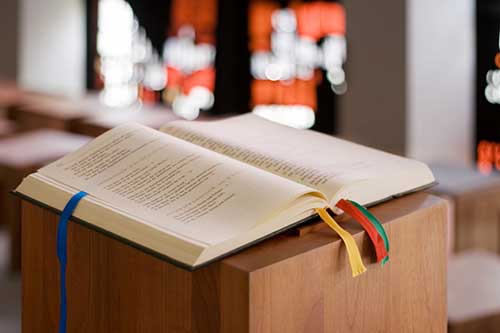
As y’all know, the lectionary (in the west) is neither a random selection of texts, nor is a comtinual progression through the scriptures. Rather, our lectionary(ies) is (are) thematic. The lectionary moves through the year, following the life and ministry of Christ. In the first half (the festive seasons), we hit the high points (the metanarrative) of His life; His life, His suffering suffering and death, His resurrection, and His Ascension. The other half is, more or less, all the rest. It’s the miracles and the sermons and teachings and the end times warnings. Around the gospel text as the days thematic anchor, the rest of the Canon of Scripture is brought to bear upon (or is born upon) the manifestation of the Gospels fulfillment in Chirst. Here is brought out the prophecy of that fulfillment in the O.T. readings, it is given voice in song through the psalms and canticles of Holy Scripture, and it is catechetically explained and or imperatively embodied through the Epistle reading. Then, these days, together with varying liturgical “propers” form seasons, and those seasons a year, and in most current lectionaries, those years form a multi-year Cycle. The shape of those lectionaries, when they vary, vary due to theological variance. The “shape” of the lectionary, AS WELL AS the shape of the day itself in the readings, conveys and communicates the theological proclamation of the churches theology. And while this is seen every season, in larger stretches of connecting texts Sunday by Sunday, it’s seen especially clear in the sharper twists and turns of the lectionary. The sharper the turn, the louder it’s proclamation.
This is seen especially in these 4 days before us now (ascension-7th of easter-pentecost-trinity), where we move specifically from the testimony of the resurrection and Christ’s revelation of Himself to His disciples through Word to the great commission, to the ascension, to the 7th of Easter where He prays for the churches unity, toward pentecost and the giving of the Holy Spirit.
The content of the seventh is all fixed around John 17, in each of the 3 years in the post vatican 2 cycle. And as y’all should already know, John 17 is a prayer for unity and oneness. Not unionism or syncretism. Not tolerance of error. But of the kind of unity and oneness that exists between the persons of the Trintiy. Not of “diversity” and acceptance or tolerance. To boil it all down to this, Jesus prays that the church be one as He and the Father are one. And that, in the context not only of following after Ascensiom Thursday, but with a textual reminder of it, having Acts 1 with it’s ascension account repeated again in the first reading of today
Obviously, as we often see, the lectionary is NOT interested (as sadly, many of our preachers have become due to reformed influences) in textual chronology Sunday to Sunday as much as thematic chronology. The prayer for unity in John 17 is preparatory towards His Ascension. But His Ascension is theologically on the move toward the consumation of this unity in the feast of pentecost. For its not in having a high priest at the right hand of the Father that makes us one, more merely hearing that we should be one that makes us one, but it is the spirit of unity that makes us one. That SHOULD be instructive on how we understand unity (and disunity) in the church as well as how the seventh Sunday of Easter is preached.
For example. What makes us “one?” Is it us? Many sermons preached on the 7th of Sunday would instruct us as if that were the case. Is it a change in our attitude? A renunciation of doctrine? A giving up of the holy sacraments? An abdnonemtn of the liturgy? Is it DOING THESE THINGS? what exactly is it?
How do we preach this? The answer comes in the shape of the lectionary. Notice the movement, Christ goes to suffer and die while all His disciples abandon Him. He rises and nobody expects Him. He appears to them and few believe in Him. Then, revealing His gospel to them through Word and Sacrament, He sends them out in the great commission. Then He ascends into heaven, and then in pentecost the Holy Spirit descends upon all. This is how all these things are done. This is how all come to believe. This is how the great commission is fulfilled. This is how the church is made one. So how are we to preach John 17s prayer (not call) for unity?
^ not as imperative. ^ not as a fixing of bad attitude. ^ but as eschatological promise of the many coming into the one (the body of Christ) through the Holy Spirit who is poured out upon the people on the feast of Pentecost through Word and Sacrament.
We preach this as a work of God, “textually” (pre-pentecost) promised, but presently (post-pentecost) now given. We are made one through the Holy Spirit. We are made one through the means by which He works. We are made one in the one faith given to us, by the Word, by the sacraments. For John baptized with water… but you will be baptized with the Holy Spirit and with fire. You will be Jesus said to His disciples. But, you have been we must now preach to our churches. The unity of the church is not about a condemnation of our anathematizing heretics or excommunication of the unrepentant. The unity of the church is about all of us, who are different people, of different cultures, different races, different ages, different contexts, brought into one body, one faith, under one Lord, and about how all of this is done through one baptism. This is a miracle, once promised, now fulfilled. That is the sermon. That is the proclamation, that is gospel.
God has made us one in Him. That’s finished work. You don’t do it. He has done it.
What a great God


