
New, Better, Greater, and More Perfect
So, as I was reading today’s texts and meditating upon them for Holy Monday, I was thinking that something in these texts seemed maybe JUST out of grasp to me. Something – just slightly out of sight. And what was it? Well, basically it’s this. You see, the Lectionary, and the way it’s set up isnt just 4 random readings given to us so that the preacher can pick his favourite. It’s not even 4 readings about the same thing or 4 things closely related given so that we can pick our favourite. No, see, the lectioanry is fit together by sewing into one every portion of the Biblical Canon – O.T. (the prophecy), the Psalm or Canticle (the Song), the Epistle (the dogma), and the Holy Gospel. And these three all feed into one another, and they all interpret one another, and they “preach” one another.
So really, the idea of Lectionary preaching is this – that if the preacher knows how to read the lectionary properly, their sermon is more or less already written for them by the arrangement of the texts themselves. And yet as I approached these readings today, I was struck by this “something” that seemed just out of reach. I knew something was there, but I didn’t quite see what it was that I wasn’t seeing. Because the first three readings all make sense. They all proclaim one message as they feed into one another and interpret one another and elaborate upon one another and preach one another.
Our reading from Hebrews teaches us that Jesus Christ is the new, the better, the greater, and the more perfect high priest, who has come to offer the new, the better, the greater, and the more perfect sacrifice, in the new, the perfect, the better, the greater, and the more perfect temple, all of which grants to us the new, the better, the greater, and the more perfect Covenant. It’s about the new priesthood, the new sacrifice, the new temple, and the new covenant, and about how much better, greater, and more perfect this New Covnenat is is than the Old Covenant of Moses was. It’s about the fulfillment and the fullness of what we had a shadow of in the Levitical priesthood and the sacrificing of animals and the temple of Jerusalem and the Mosaic Covenant – and all of that being fulfilled and perfected in Christ who is the fullness of all things promised and prohpesied.
It’s about what was promised, and foreshadowed, and prefigured, finally coming into fullness.
And our O.T. prophecy says the very same thing to us, that the one who is coming (who has now come) will not lift up His voice, nor shall His voice be heard at all, but like a sacrificial lamb led to the altar for ritual slaughter he is silent. For He is the lamb to be sacrificed. He is the new lamb, the better lamb, the greater lamb, and the more perfect lamb. He is the fullness and the fulfillment of that O.T. lamb. For God has given Christ to be a covenant for us. For the New Covenant, the better covenant, the greater covenant, and the more perfect covenant comes to us in His blood. And this Christ, given to us as our covenant through the shedding of His blood will be the light to the gentiles, light to those who sit in darkness, and life to those who shit in the shadow of death. It is the shedding of this true Passover Lamb’s blood that will bring liberation from our captivity in sin, and will restore sight to the blind, healing to the deaf, and animating the body of the cripple. For His death – is our redemption. His death is our healing. His death is our life. For all that which was promised, Isaiah says, all that which was promised long ago and prophesied in ancient times, all of that has finally now in Christ come to pass. All of that has been fulfilled. All of that has come in flesh.
And that flesh, Psalm 36 proclaims to be the true feast of God’s house which satisfies not only body but also our souls. For His flesh is true food. And His blood is true drink. For up on that cross as the dead Christ’s side was pierced through with a spear, out came a flood of blood and of water. The living water, spilled and poured out from His very heart. His blood, mingled together in one cup, the fountain of life, the stream of our delight, that we might drink of it, and never die.
And all of that makes sense. Hebrews and Isaiah tell us about the promised fulfillment of the Old Covenant to come in Christ, the better priest, the better sacrifice, the better temple, and the better covenant – promised, and fulfilled, and then Psalm 36 brings all of that from the cross / TO the altar, so that we can not only see this lamb slain for us, and believe in this lamb slain for us, but actually partake of, and eat this lamb slain for us in the sacrament of Holy Communion.
But then as we come to the Gospel – which should by all accounts be the narratival capstone of our readings, and we see ——– what? Mary anointing Jesus with costly perfume our to prepare Him for burial. And we think, well okay, that’s good enough I guess, it ties everything together, in a way. Jesus is the new priest who sacrifices Himself as the new sacrifice to BE for us this new and eternal covenant. And – well, to do that He must die, and so this is about His death – and that makes sense.
Truly, if we stop here we have a great confession. If we stop here we have a full and a robust theology of the covenants and of Christ and of His priesthood and His sacrifice and of the temple and of our salvation in Him and even of the Sacrament of the Altar – here, really we could go for multiple days.
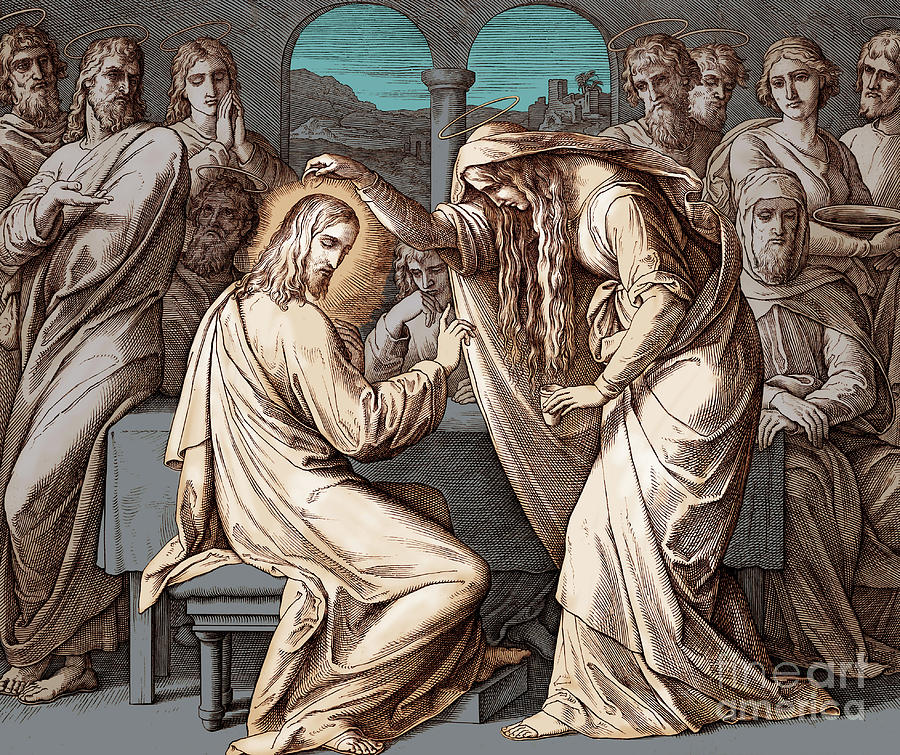
But notice with me if you will, what Mary does. Just six days before the Passover that He had come to fulfill through His death, Mary does something to Him. And this thing she does to Him, the text tells us, in a sense and in a way, prepares Him for burial. But – it does more than this.
What does she do to Him?
She, and I quote, V. 3, “anointed” Him. Our text today in John mentions only His feet, but Matthew and Mark state that she took this alabaster jar of pure nard, worth 50 or 60 thousand dollars, broke it open, and poured it over the head of the Lord Christ.
And what is this? Whats? Happenign? What does that mean?
This is preparation for burial, yes, but this also speaks to us of Chirst’s priesthood. For just as we heard that Christ is to be this covenant, by this sacrifice, so it is also true that the sacrifice is made BY the priest. And the priests in the O.T. were made, how? Ex 29, “This is what you shall do to them to set them apart as holy, so that they can minister to me in the priest’s office. Bring Aaron and his sons to the entrance of the Tent of Meeting and wash them with water. 5Take the garments and put them on Aaron: the tunic, the robe to be worn under the vest, the vest, and the pouch. Clothe him with the sash of the vest. 6Set the turban on his head and put the holy crest on the turban. 7Then take the anointing oil and pour it on his head to anoint him. Then they shall possess the priesthood by means of a perpetual regulation. You shall ordain Aaron and his sons for their work.
This is all over Exodus, and this is all over Leviticus – two books that are extraordinarily relevant for understanding Holy Week – because there in these books are the promises, the shadows, the prefigurements, and the context of what occurs for us in this most Holy of Weeks. Becuase there is the priesthood. There are the sacrifices. There are the temples. And there is the covenant. All of which if we are to understand Christ, and what He has done for us must be known and understood. And there in these books, it’s that stated that what is required to make this sacrifice, which in turn grants this new and perfect covenant, is the priestood, sanctified and consecrated through the anointing of Aaron’s sons with oil, made ready to make the sacrifice!
And just so in that very way, what we see in John 12, or in Matthew 26 or Mark 14, as Mary anoints Jesus in preparation for His burial, is that Mary is anointing Him also to prepare Him to offer His own life as a sacrifice for our sins on the cross. She at once prepares Him to make the priestly sacrifice. She at once anoints the tabernacle. She at once anoints the altar. She at once anoints the priest. And she at once prepares the sacricial victim for burial. She in one shot, prepares and signifies by her actions that what is to happen here at the end of this week is a fulfilling and a completing and an accomplishing of all that which was foretoled, prefigured, and foreshadowed in the Old Testmaent Law, in Exodus and Leviticus, with its priesthoods and sacrifices and its temple and its covenant.
And the good news of that, is that all that which we have and proclaim and consider is fullfiled in Him, in this person of Chirst. And that means that it is finsihed and it is present, and it is freely given, and it is for you, and that it is here.
The temple is fulfilled in Christ. The temple is no longer a building made by hands. The dwelling place of the God who dwells with men is not so much a place as it is a person. Holy ground is no longer about a where, or a what, but about a who. Who is here? For the temple is not a church building, or a cathedral. But the body of Chirst. His flesh and His church. We don’t wait for a new structure to be rebuilt in Jerusalem. We don’t look for the most fanciful or beautiful buildings. But we look to Christ – we looked to where His flesh is given, we look to where His church is living , and there we see the presence of God with us. For where His Word is, where His sacrament is, there is promise and His presence with us and for us.
The Priesthood of this present God is fulfilled in Christ. That is, the priesthood – literally, those who offer sacrifices to God on behalf of the people, serving as the mediator between God and men. THAT priesthood, finds its fullness and completeness IN CHRIST. And THAT MEANS, that it’s no longer sinful men. It’s no longer fallible sinners. That stand between you and God. Or that offer sacrifices on your behalf to God. And that’s good news. Because as you go and look at Exodus and at leviticus what you see is again and again this necessity that the priest offering the sacrifice must be perfect. They munst have no blemishes. They must have no sins. They must have no physical infirmities. Their children and wives must be perfect. They must have no uncleanness. And who can live up to that? Only Christ. – Only Christ can, at once, be utterly without sin, compeltely without blame and perfect yet also be one of us, know us, and empathize with us, and relate to us as our fellow man.
But not only is this Christ our priest, but He is our sacrifice. For so too must the sacrifice be pure. So too must the sacriifce be blameless and spotless and without defect. Yet – even still, and even so, as Paul tells us in His epistle to the Hebrews, even though the priests offered this sacrifice again and again, day after day not a single sin, and not a single person were forgiven. It was never possible for the blood of bulls and goats to take away sin. Because these things were merely the shadow of the fullness that was to come. But now, that fullness has come in Christ. And now in His sacrifice our sins have been forgiven. For in that sacrifice we have the new, the better, the greater, and the more perfect and Eternal covenant in the blood of Christ who is the true Lamb of God, the sacrifice for every sin, of every perosn, of every place and every time, forever.
And therefore the Covenant too is fulfilled in Christ. And that means that your salvation is fulfilled in Christ. Becuase while the Old Covenant bound us to perfection in holiness in order to obtain and sustain our relationship with God, and receive the reward of presence with God, the new covneant grants this to us freely, by way of the forgiveness of our imperfecitons, our sins, and our spiritual blemishes. The old covenant doomed us from the very beginning. But the new covneant IS itslef the resurrection from death, it is the sight to the blind and hearing to the deaf, it is justifiation of the damned and it is hope for the doomed. For while the old covenant demanded us to be without sin. The new covnenat IS the forgivenes of our sins. The Old covenant required us to be perfect. But the New Covnenat makes us perfect through the blood of the one who was for us perect.
In Him you are forgiven, in Him you are reconciled, in Him you ARE perfect. And it is HE who comes to you this very day, through His flesh given, and through His blood shed, the perfect sacrifice, offered by the perfect priest, in the perfect temple – given for you to eat and to drink of this new covenant in His blood – the true feast – the fountain of life.


