
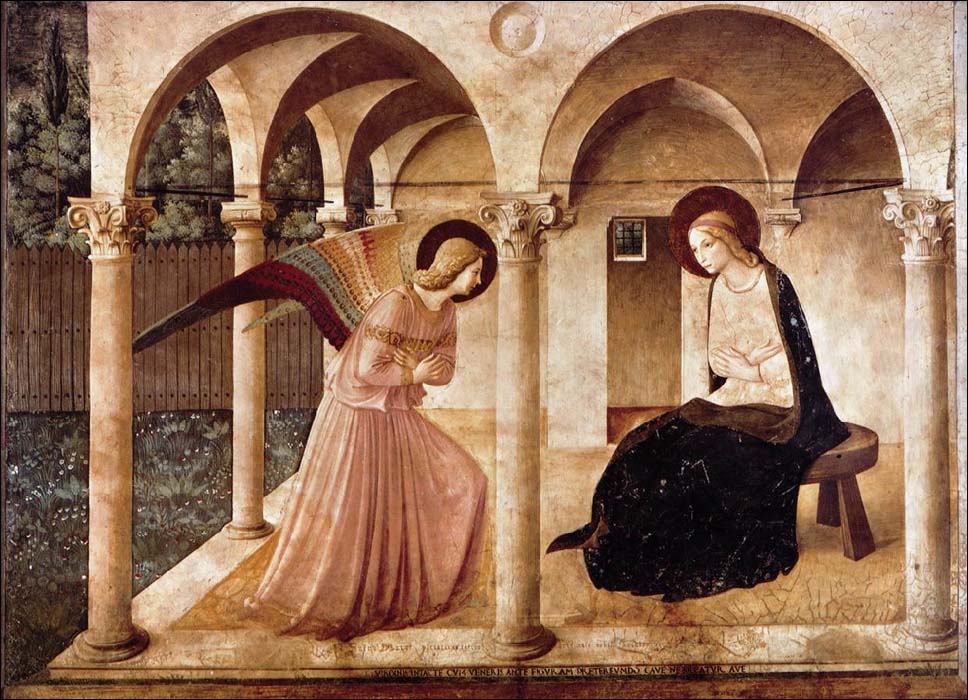
You’ve all heard of Christmas in July? Its the idea (and practice) of celebrating Christmas (usually with ones extended family) outside of the normal Christmas season. Well, that’s what today is, in a sense. Though it isn’t July, it isn’t December. And this isn’t Advent. And this isn’t Christmas, and yet here we are in Lent, celebrating the feast of the miraculous conception of our Lord, conceived by the Holy Spirit, and born of the Virgin Mary. And we do so, every year in the thick of Lent. That is to say, that every year, 9 months before Christmas, we celebrate the announcement of Christ’s coming birth, and celebrate His miraculous and virginal conception.
And really, this is not only fitting, but it’s perfect. Because this week, every year, the church celebrates not only the conception of Our Lord, but celebrates it during the season of Lent, which is when we focus most particularly upon His suffering, His death, and His resurrection. And if anything, what this reminds us of, is the fact that Christmas and Easter are not far apart, but that they are inseparable, and that they are interconnected, and that the one exists for the other.
For Christ was born why? Christ came to this world why? Christ came to dwell among us why? God took humanity upon Himself and was made man, incarnate, in flesh, WHY?
Not to just merely be with us and among us, AS US, or like us, but in order that He might actually DIE FOR US.
As we heard in Hebrews 10; Christ came why? Behold I have come to do Your will O God, to do what is written of me.
For the blood of bulls and goats could not take away sins, for sacrifices and offerings Lord, you did not desire, these Lord, you did not desire, But a body you have prepared for me, Our Lord says, to do your will, that by the sacrifice of this one man, by the death of this one man, by the offering of this one body of this one Christ, all men, all sins, might be forgiven.
This is why Christ has come. It is for Good Friday that we have been given the feast of Christmas. For our Lord was not born so that He might live, but to die, that WE because of Him, might live.
And is this not exactly what we see in our Creeds? And in our catechisms as they expand upon those creeds? For in the second article on redemption, there we find TOGETHER both Christmas and Easter. Christ has come, and Christ has died. This is not two messages, but one message. For God came among us, to be with us, EMMANUEL that He might die for us.
And so we have my friends, Christmas in Lent. Today we celebrate the coming of Christ. The breaking forth of Light into darkness. But that light is born into the darkness in order to take all of that darkness upon Himself. And to suffer that darkness, even unto death, the death for us on the cross. Christ has come that He might die. And He has come to die, that we might live. My friends, do you see?
Today’s feast, todays celebration, todays texts and todays message are about Christmas. But Christmas… Christmas is about Lent. Christmas is about the coming of Christ, btu the coming of Christ is about the suffering and death of Christ,
For Our Lord has not come to live, but Our Lord has come to die that WE might live through His death.
For as we confess; [I believe] in Jesus Christ, his only Son, our LORD, who was conceived by the Holy Spirit, born of the Virgin Mary, suffered under Pontius Pilate, was crucified, died, and was buried, descended into hell, and on the third day He rose again from the dead.
This is the Gospel, this is the faith, this is Christmas in Lent.
And here is found the gift of eternal life, of the forgiveness of sins, and of eternal salvation, freely given. For to us this day a child is born, unto us a Son is given, and we shall call Him – Lamb of God, sacrifice for sins, and death of death. For He has come to do the will of God,
Merry Christmas
Blessed Lent


