
Prayer and devotion have historically been central practices of individual life and the church. We have often termed these spirituality or piety. Many saints of the past have written on this necessary, and at times, poorly understood topic. Often in broader evangelicalism the “health” or “measure” of one’s faith is considered directly proportional to the amount of time spent in prayer and reading the Bible. One might think of examples like My Utmost for His Highest by Oswald Chambers, The Imitation of Christ by Thomas a Kempis, or The Pursuit of Christ by A. W. Tozer. Granted, all of these examples are within a certain vein of understanding devotion and spirituality. The Church Fathers wrote heavily on this, often through hagiography (the account of the life of a saint meant to spur one on to live a life of holiness.) The issue with these accounts is that they turn prayer and devotion into a law, a ladder to be climbed on our way to becoming more Christ-like.
As Lutherans, we reject the idea that good works in any way increase our holiness. Righteousness does not come from the law and what we do, but rather comes from faith in Christ. This does not mean that Lutherans reject the idea of encouraging prayer and devotion…that would be quite ridiculous. Prayer is a central theme of the Bible. There are approximately 650 prayers in the Bible, and the word is used about 120 times in most modern translations. The most famous example of prayer in the Bible is found in Matthew 6:13-19, what has become known as The Lord’s Prayer. This passage has been used for years as a model prayer for believers.
However, if you ask most people about their devotional/prayer life you will get generic, fumbling answers about how one tried X reading method, or Prayer method Y. Many do not know where to begin. The reality is that the Lutheran tradition has some of the greatest resources available for devotional life. The term gospel imperative is one of the most horrendous confusions of Law and Gospel humans could imagine, but if there ever was one thing we could call a gospel imperative it is 1) read your Bible and 2) pray. We do not do these things to be “better Christians”, rather these practices are for the comfort and growth of one’s soul. A rich inner devotional life is the balm for what Luther calls Anfechtung, or Søren Kierkegaard called Anxiety. In short, these practices are an “appeal to God for a good conscience”. A heart that is burdened or run down will hardly find a better dose of grace than talking to God in prayer or reading the Word of God.
The perennial question is…how? How do we do this? My purpose here is to provide resources to get people started in a helpful way on the practice of daily devotion. The Lutheran tradition, old and new, has provided quite a few resources that help guide us along the way. This is by no means an exhaustive list, but the goal is to provide a solid starter list to get people on the right track. I will briefly cover Bibles, devotional books, prayer books, and all-in-one resources.
Recommendations
Luther
First a word about a few Luther resources on this topic. The education and devotional life of the everyday man was central to Luther’s concerns. He translated the Bible into vernacular German so that people could read in a way they understood. Luther’s Small Catechism was written to provide a lifelong resource for the education and edification in the faith. It consists of short explanations of the Ten Commandments, Lord’s Prayer, and Creed. I recommend the CPH Luther’s Small Catechism with Explanation (2017 edition). The form factor is quite nice, well bound hardback with paper suitable for marking with thoughts. You can also get it in spiral bound with ruled margins for note taking.
Luther also wrote his short Morning and Evening Prayers for people to have a simple way to engage their children and themselves in prayer to God. One of Luther’s most famous and helpful resources is A Simple Way to Pray. In this extended letter written to his barber he lays out a very simple method for prayer using the Commandments, Lord’s Prayer, and the Creed. Harrison lays this method out as “I.T.C.P.”: Instruction, Thanksgiving, Confession, and Prayer. I very commend this simple and direct book as a place to begin if you are unsure how to start the practice.
One secondary resource I recommend is John T. Pless’ Praying Luther’s Small Catechism. This short book pulls together a lot of resources on the catechism. It teaches about the background and spirituality of the catechism. It is only 182 pages long and is easily broken up for meditation and can be taken in bite sized bits.
A final resource from the pen of Luther himself is published as well by CPH. Reading the Psalms with Luther is a wonderful resource for daily prayer of the Psalms alone or with groups. Each Psalm has a short explanation from Luther and is laid out metrically. Using the provided tunes in the front, with little musical knowledge you can be singing the Psalms together with your family. I would also note music helps solidify things in the brain and this is a good resource for memorizing the Psalms or observing the traditional prayer hours.
Bibles
A quick word about the Word (pun intended). Let it first be said, the best Bible is the one you will read. Any modern translation (not paraphrase) will suffice in a pinch. That being said, not all physical Bibles are created equally. I am not particularly a proponent of reading plans in their contemporary form. There are, however, a couple considerations I would encourage. Don’t be afraid to spend some money on a good Bible. This isn’t some reverse psychology to say well I spent money so I should read it, but simply, there is a wealth of premium Bibles on the market and they last and are easier to read.
If you like ESV I highly recommend Crossway’s premium editions. If you like NIV, NASB, or NRSV I recommend Zondervan Premier Editions. For CSB, Holman has really good editions. If you are really interested in a myriad of translations in a super premium format I recommend checking out either R. L. Allan Bibles or Schuyler, the housebrand of evangelicalbible.com.
One of my favorite ways to read that gets around the verse and chapter counting is a Reader’s Bible. This format removes references and verse numbers and usually just includes chapter numbers. It formats the Bible just like a standard novel. This is quite nice for reading more extended periods. There are great hardcover editions of ESV, NIV, and CSB Reader’s Bibles. This format has become much more popular these days so you can probably find most prominent translations in a reader’s edition. If you want something more universal for usage I really recommend a single column, paragraph setting of the text as it reads more naturally than more broken up formats. But, in the end, the best Bible will always be the one you read.
Book of Concord
It is hard to talk about the practice of Lutheran piety and devotion without attention to the Book of Concord. Originally finished in 1580, it is a compilation of documents from several Lutheran reformers and is the cornerstone for the Lutheran faith. But these documents are not simply dry doctrinal statements or dusty books of theology. They are lively documents that are rooted in the care of souls and pastoral concern. A steady diet of the Confessions will enrich the mind and soul.
There are several editions of the Book of Concord. We need not cover them all here, but I will briefly talk about two of them. If you are interested in a more scholarly edition with extensive footnotes and more critical translation I recommend the Kolb/Wengert The Book of Concord: The Confessions of the Evangelical Lutheran Church (known by its blue book cloth cover). This is my preferred edition for academic study and more scholarly work.
My recommendation for the average person is the CPH Concordia: The Lutheran Confessions (burgundy and blue edition, matching the Small Catechism discussed above). This is a reader’s edition and has a lot of helpful tools in it. For one the form factor is more warm and user friendly. The cream colored pages and more modern type set lend themselves to a very nice experience. It has a friendly user guide and has a yearly reading plan that I think is extremely helpful just for the exposure that it provides to the Confessions. There are no footnotes to this edition, keeping people from information paralysis in their study. The indices in the back also provide helpful guides to terms, Scripture references, and even includes a section on art in the Reformation. Just like there is no way to spend too much time in our Bibles, we will be hard pressed to have too much exposure to the Confessions.
Best Single Volume Resource
In traditional Roman Catholic spirituality you have what is called a breviary. It’s a single volume that covers the daily text of the lectionary and a lesson on the text. Anglicanism followed suit in this practice with texts such as The Book of Common Prayer and The Anglican Breviary. Lutherans have not made as much use of this method as I think they should have, but I digress. Thankfully, now there is a great single volume option from CPH called The Treasury of Daily Prayer.
This volume is by far the most helpful single volume Lutheran breviary that is available. It contains the whole daily lectionary, a lesson from a Reformer or Church Father, section of the Confessions, daily prayers and more. It walks one through the whole church year and is guided with the tradition and wisdom of the past. It makes it so easy that one doesn’t really have a good excuse NOT to be using it. It keeps you in rhythm with what is already done at church, and expands on that. You can use it in various ways, public or privately. Once again, another great resource to make daily practice of worship and devotion at home so easy. It comes in multiple editions and even a compact edition, though warning on the small font for that one.
Best Multi-Volume Breviary
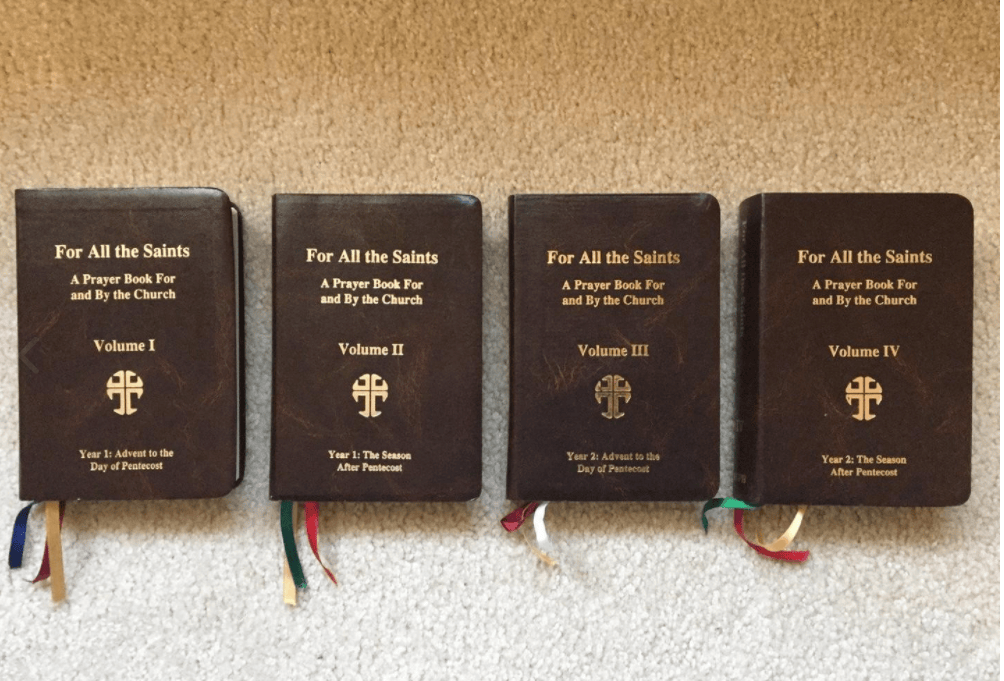
For a slightly older, but still very helpful edition I recommend For All the Saints: A Prayer Book for and by the Church. This is an amazing four volume set that follows the liturgical calendar as well. The binding is beautiful and the volumes are very usable due to their size. There are OT and NT readings, morning and evening prayers, and daily lessons on the texts. The translation used in these is the older RSV, and while this is somewhat archaic and seemingly formal, it is a great translation that can bring something of a poetic element to your devotions. The only con with this particular set is the cost, about $140 new for the set. You could of course try and collect them all individually but for the price I have seen them going for, biting the bullet for the new set is recommended. It is also keyed to the services and Lectionary of the Lutheran Book of Worship. This gives it a broad usefulness and grounding across many Lutheran bodies in North America, as this is a primary hymnal for many groups, including my own LCMC. Overall, it is a fantastic resource that probably most accurately captures the spirit and style of classic prayer books and historic breviaries.
Concluding thoughts
My hope with this short piece is to hopefully provide some basic tools to equip Christians in their daily life. A life of prayer, reading, and meditation is one that Luther encouraged, the tradition encourages, and one I commend myself. Do not be afraid to take up and read! In fact, this is a great topic to address as we head into the Lenten season of 2022. Whether you are giving up anything for Lent or not, ADDING something for Lent may even be more helpful. Please do not take this as law or command, but an invitation to experience the Gospel new everyday. You will never be more holy than, but one might find the soul and mind soothed by a daily practice of piety. I am not always good at it, and to be honest, you and your pastor probably struggle with this too (that’s your Old Adam and the Devil by the way). But, we will never find ourselves in the Word too much. You cannot pray too much. So take heart dear Christian. Take and read for the Lord is good and his mercy endures forever.
About Stephen
Seminarian at Luther House of Study. Lives in Washington State just north of Seattle with wife Sage, three kids: Ezra, Juniper, and Mairead (Maisie), and dog Remington. Manufacturing Manager in the aerospace industry. Southerner, former chef, and enjoys a good adventure outdoors. When I am not reading/writing or adventuring with family, I can be found baking bread or playing guitar.
Comes from a Free Will Baptist background and holds a BA in History and Theology from Welch College. In pursuit of MDiv at LHOS, with future plans for graduate work in philosophy and theology. Convert to Lutheranism, currently in LCMC Augustana District, helping at Denny Park Lutheran Church in Seattle, WA.
Broad interests pastorally and academically. Jack of all trades, master of none. Enjoys reading and writing about modern German history (social and intellectual), theology, and history of philosophy. Specific topics of interest: Intersection of theology and philosophy, Dietrich Bonhoeffer, Kierkegaard, Post-Barthian German thought, and influence of Existentialism and the Continental tradition on theology, especially pertaining to Hegel and Heidegger. Very interested in how philosophy is related to proclamation.


