
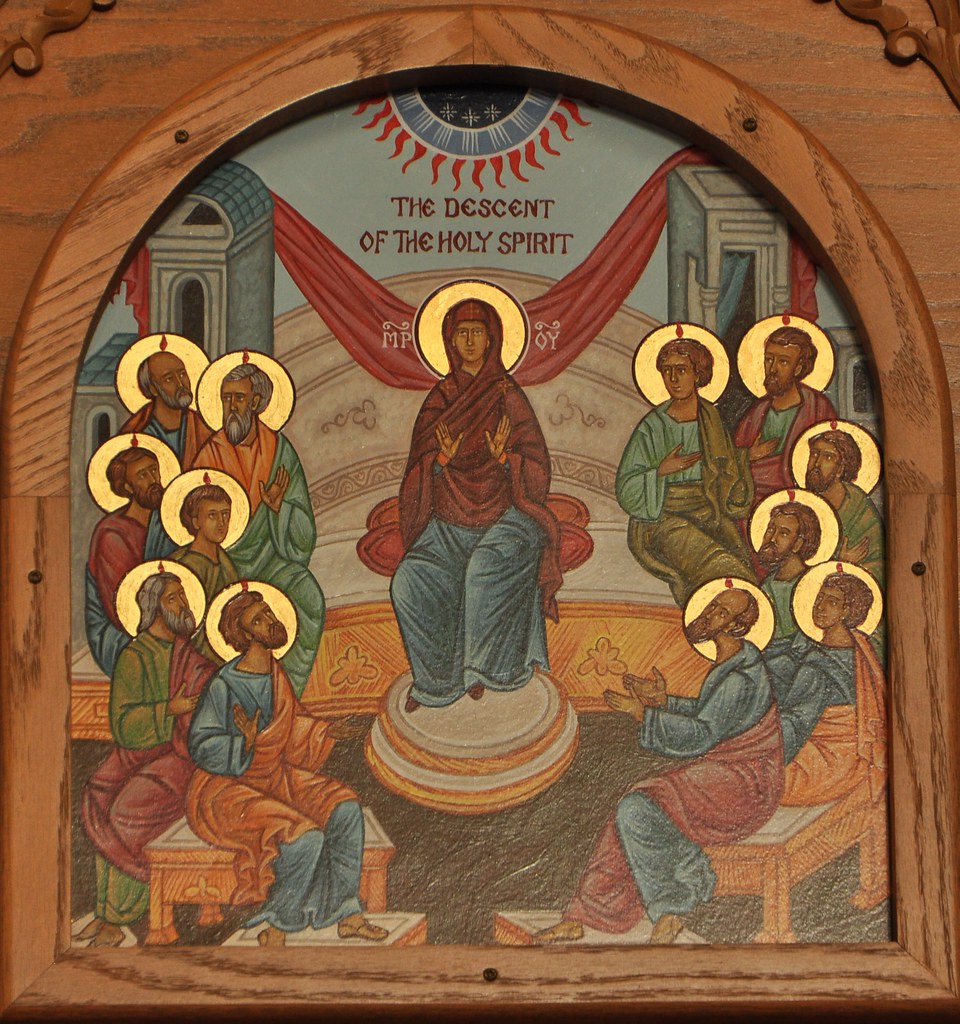
The special “Pentecost text” today, is the text of Acts 2. This text is the account of the disciples meeting on the O.T. Jewish festival of Pentecost, a day set to come together and celebrate the giving of the Old Testament Law, the Old Covenant, the commands. And as is famously known about this event, is that it was on this day, when they were gathered, that the Holy Spirit was poured out upon them, and they began to speak in tongues. It’s this speaking in tongues that is so often spoken about, and indeed, that’s what we’re going to speak about today.
The text says, that as the Holy Spirit was poured out upon the apostles, they began to speak in tongues. Now, these tongues, as the text says, are not comprised of babbling nonsensical gibberish, but the tongues spoken of here are languages, that the Jews in Jerusalem said, “wow, what is this, I hear all these crazy Galilleans speaking my language, how is this possible?” They’re speaking Latin, Gallic, perhaps Ethiopian was spoken, so on so forth. And while this certainly got the attention of the people, so that Peter could preach His sermon to them, there was, implicitly, one very important new tongue or new language that was spoken that day. You see, the Jews, the disciples even, were here to celebrate the giving of the O.T. , the Old Covenant, the Law, the commandments. They came to celebrate a feast about being told what to do and what not to do. Whether we are french, English, Portuguese, etc, we are all raised to speak the same language, the language of Law. The language of do this or else. The language of I deserve that new raise because I worked hard, the language of vindication by worthiness, and condemnation by failure. But this day they spoke a new language, and they did so in many tongues. In Greek, Slavic, Arabic, – the gospel was proclaimed. That God, the judge in heaven, who gave those very commands that we broke, became a man, to share in our burdens and our suffering, to take our sin, and to live under His own Law, to redeem us, to renew us, to reshape us, and to raise us up from the death that we inflicted upon ourselves, by suffering it for us and in our stead. A new language, a new tongue, – “everyone who calls upon the name of the Lord shall be saved”
see, Jesus had been trying to teach His disciples this new language for 3 whole years but they just weren’t getting it. This reminds me of when I was growing up, and I, as all children, had to take french classes. My mother’s side is french and Irish, so you’d think that with the help of native french speaking grand-parents I would have done well. But I didn’t. The teachers tried and tried to help the language stick with me, but I kept lagging further and further behind my fellow students. Eventually, the methods of teaching languages in the school system changed, and they realized that for many students, having hand gestures to go along with the sounds and the words helped their brains to remember what they were learning. Not only was I studying under a master of this method, but the very woman who pioneered it, her name, ironically, was Madame French.
This method, reminds me of that used by Christ Himself. Not only did Christ preach the new language of forgiveness, and freedom from the Law, but Christ actually along with this preaching forgave sins. He didn’t just preach eternal life and salvation, He gave it. And not even as a merely internal reality of the heart, but He freed people from demonic possession, He healed the crippled, the blind, those with leprosy, He even raised people from the dead. All of this was new, the language of forgiveness, of healing, of life, of resurrection, of freedom, and not as payment for righteousness but as a free gift of grace, this was all new. This had to be learned.
But no matter how hard I tried, no matter how much extra curricular tutoring I got, Madame french could not teach me french.
And so the school system deemed me, French-exempt, and I got a free spare period of school while the others attended french classes.
The School had deemed me dead in my inability to learn french, in bondage to my English tongue, unable to free myself. Just as St. Peter and the other apostles, could not, no matter how much time they spent with Christ outside of His regular ministry, being “tutored” as we might say, in this new language of grace, they could not learn it. Because they were dead in their trespasses and sins, in bondage to sin, unable to free themselves. They were, grace-exempt. And When push came to shove time and time again as it always does, they tried to gain superiority over one another, condemn those who were preaching Christ apart from their little circle, and they habitually misunderstood the purpose of Christ’s coming as the Messiah. Even St. Peter, after his confession of faith that Christ was the Son of God, then turned around and rejected the gospel in the same chapter, and was called Satan by Christ Himself. But most of all, when that time for Christ to die had come they had all left, none of them actually had believed what Christ said. They had memorized it, with Christ saying it so many times, that He would be condemned by the high priests, put to death by the Romans, and 3 days later would rise from the dead. They knew this, but they didn’t believe it. Because when Christ was out of sight, when the gospel was out of sight, when their eternal hope was out of sight and the only thing they could see by the eye was despair and loss, there was no faith. The following of Christ persisted so long as Christ was before their eyes. These disciples could not learn this new language of grace, they could not create this faith within themselves. And Neither can we.
But Jesus does not leave us here. Even after He had risen from the grave, alluelia and amen, holy as it is, we can be certain of what was racing through the disciples’ minds. Oh no not again, He’s leaving again. And then what? What if we forget what we saw, what if other’s don’t believe what happened, what if we begin to think that this was all some sort of dream or a vision, Lord please don’t leave.
But in leaving, Christ says, I am leaving, but it is for your benefit. Because when I leave, to fill all things (Lo, I am with you always, everywhere, reigning as king), I will send the Helper, the comforter, the sanctifier, The Holy Spirit. He is the Spirit of truth, and He will bear witness about me, and He will convict the world of their unbelief, and plant in them a living faith and trust and certainty in the gospel of Christ Jesus the God made flesh, who lived among us, suffered with us, died for us, and rose in victory over death and the devil themselves.
The Holy Spirit is not like a Tutor, helping us to rely on our own mental faculties, reminding us of the correct answer to the question on the test, and correcting us when we err. Christ spoke that new language of grace. But we, no matter how much tutoring, no matter how much sign language was used to assist in our learning, were consigned to our ignorance, our tongues were locked in place, and our lips, sealed closed, in regard to that new language. But our epistle reading tells us of good gospel news. That these men, on that day of Pentecost, on that day of the old language of Law, were filled with the Holy Spirit, and they spoke in new tongues, and here’s the point I want you to grasp, as the Spirit gave them utterance. Christ does not expect you to speak this language on your own, but He promises that He will loose your tongues, and they will, they will speak grace. So as you hear these words today, know that they are in a new tongue, and that as you hear them, and understand them, and learn them, and speak them to yourself and to another, that a miracle is happening. That you are speaking in the language of grace, not of your own will, but as the spirit gives you utternace. To err is human, to forgive is divine. Brothers and Sisters, I bid you, speak this language of grace; “And it shall come to pass that everyone who calls upon the name of the Lord shall be saved”


