
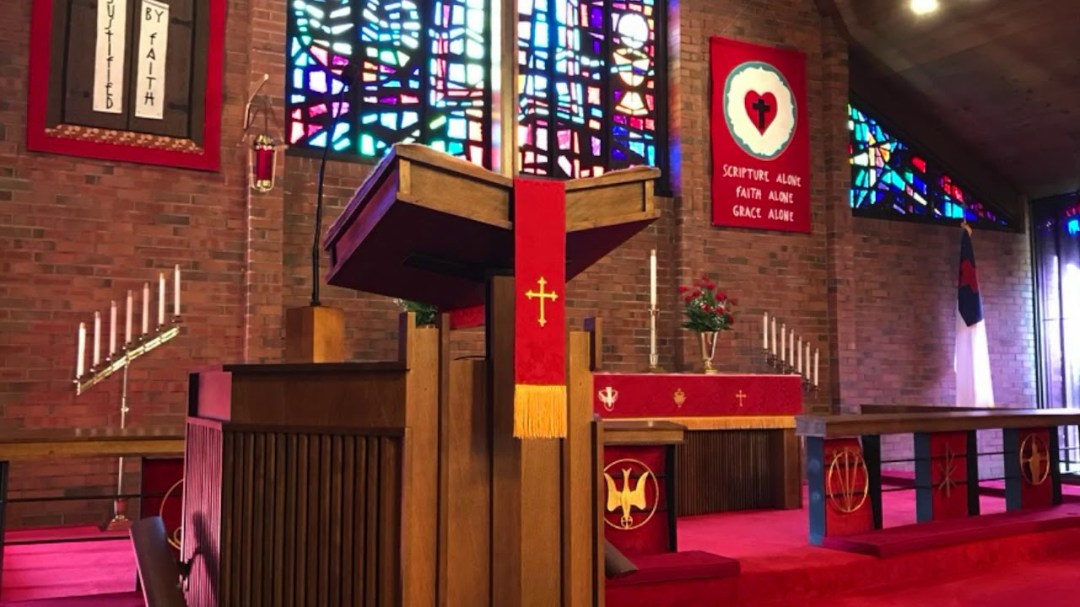
Assertion: It’s blasphemous that people have replaced the term “divine service” with the term “worship service”. Okay, let me attempt over the course of this blog post to explain what I mean before I get slapped with labels like; Pharisee, Legalist, precisionist, demoniac, etc.
Divine service was the term used in the majority of Christian churches in the past (the ancient church) and the present (Romanists, Eastern Orthodox, Anglicans, Lutherans) to refer to what happens when we gather on the Lord’s Day. It means God’s service. That is to say, His service to us. The term commonly used today in Evangelical and Reformed churches is “worship service”. This term clearly points to a service we do to God as God doesn’t worship us. That’s right, I’m not positing worship service as a true statement of what we do when we gather on the Lord’s Day. In fact, I’m saying it’s blasphemous. Eucharistic sacrifice (a sacrifice of thanksgiving) is part of the liturgy (order of service) but it’s not THE liturgy (literally rendered as work of the people). The Lord’s Day service is a Divine service, not a worship service. Yet in the divine service, we have Eucharistic sacrifice, we have worship. But the majority of our Eucharistic sacrifice that we do is outside of the Divine service. As Paul clearly says in Hebrews 13:16 (yes, Paul wrote Hebrews) they are in our doing of good works to our neighbors. You want to serve God? Good. Go and give to the poor, feed the hungry, clothe the naked, shelter the homeless, and visit those in prison (Matthew 25:31-46). Christian service to God, in our lives, in Christ’s life is always to do God’s prescribed will regarding others. Again, God neither needs nor wants. Our Eucharistic sacrifice AKA worship is not why we gather, it’s the result of gathering. When we gather we offer God nothing. Even our Eucharistic sacrifice is not offered, We sing ideally songs he gave us, read the Word He gave us, and pray the prayers He produces in us. In the songs, the sermons, the Scriptures, we hear His voice. We hear law and we hear gospel. When God speaks we receive grace. Yet within those songs and those prayers and the sermon God will be exalted. But the purpose is to hear from God and to bring to Him our intercession and our supplications. And in those intercessions and supplications, all we offer is a request to have grace offered to us. How have we forgotten so soon what the ancient church taught us? We come to the service as lowly beggars who can offer nothing, receiving from the table what our Father gives us. The service is not a give and receive. When the primary focus of the service switched from divine service/God’s service to “worship service”/man’s service, it showed a complete shift in the minds of evangelicals and the Reformed regarding what we gather for. The focal point of Christian practice is the service. So what happens when it goes from a divine service to a worship service. It’s a complete shifting of the terminus and telos and purpose of the Christian practice. A Life of Grace? Or a life of pleasing God? See, being obedient to our vocation pleases God, but it doesn’t serve God. We cannot serve one who neither needs or wants. One who is self-sufficient. Let’s not forget that divine impassibility goes both ways. When we do a good work or are obedient to our vocation it is always to other humans.
The Evangelicals and the Reformed see the Christian order of practice this way: God’s grace enables us to please Him > God’s pleasure in being worshiped < our pleasing God.
Even a basic Romanist or Eastern Orthodox sacerdotalist system understands the cycle of Christian practice better than this. Don’t get me wrong, it’s better to be right on justification than on the telos of Christian practice. But our conclusion on this issue influences the mindset of ourselves and those around us either consciously or subconsciously.
The truth is this: God gives us His grace so that we can have union with Him > as a result of living in this union with Him we show forth a likeness of Him in our giving of Grace to other humans > God is glorified primarily in giving grace, not in exaltation. In grace is He most pleased. “I desire mercy not sacrifice” – Matthew 9:13.
You really do see that one, namely the former in its practice shows itself to be “a theology/practice of glory”. Not as Luther meant it (though that is debatable), but as I understood it when I first heard the term. As a theology focused on the law, on the righteousness of God, on His power, on His exaltation, I thought in those things God would be optimally glorified. It was something that as a young Calvinist excited me and became for me my greatest idol. And the other shows itself a “theology/practice of the cross” as Luther would have said, with its focus upon the ground, means, and application of grace. If our liturgy is focused upon and centered around the reception of the means of grace we should call the service God’s service to us. If our liturgy is not focused and centered around the reception of the means of grace it should be thrown away and condemned as will-worship. Where is God mostly and primarily glorified? In people exalting Him? In Him showing His power? If that were the case He would not have come as a meek servant savior. In Romans 9:22-23, God makes it clear that the only reason He punishes is to show the wonder of grace. “What if God, desiring to show his wrath and to make known his power, has endured with much patience vessels of wrath prepared for destruction,in order to make known the riches of his glory for vessels of mercy, which he has prepared beforehand for glory”. For me this is clear, vessels of wrath are to show power, vessels of mercy are to show glory. Tell me again dear reader, how is God primarily glorified? Mercy… It is mercy. Everything, even His wrath, is seen through, goes back to, and relates to – mercy. In the Mosaic epoch, we would go and sacrifice first a justifying sacrifice of blood, then a grain offering of thanks and then an optional extra non-blood sacrifice almost like the giving of alms. The second is the “worship” the “Eucharistic ” sacrifice. The first one is the atoning sacrifice. The obvious primary focus of the temple cult was the atoning sacrifice. Both those offered daily and those offered irregularly, such as the day of atonement. In fact, the surrounding area around the temple was known for having blood flowing through the streets constantly. It was not known for the excess of grain offerings. Let us not think that the grain offering was the focal point of the temple cult. Let us not even think they shared equal importance. It was and is still the afterthought. It is the thing which necessarily flows from the reception of saving grace. A fruit of grace. In fact, that was the sin of Cain, who instead of offering an atoning sacrifice went straight to “worship”. Friends, there is no worship without blood. And before one here objects and says, “ah, yes, but that was only because God only desired the worship of justified men and women”, think again of Matthew 9:13. For God already had abundant worship in heaven from the angels. Indeed cannot God even summon the rocks to worship Him? Isaiah 55:12 reads; “the mountains and the hills before you shall break forth into singing, and all the trees of the field shall clap their hands”. And this is not an isolated concept. Job 12:7-10, Psalm 96:11-12, Psalm 69:34, etc. It is true, mind you, the “worship” of the unjustified is to God a stench in His nostrils (Amos 5:21). But we cannot press into this truth the assertion that therefore the end of salvation is the worship of God. The end of salvation could rightly be stated as the renewal of a fallen world, covenantal union between God and man in Christ Jesus, amongst other things, but most truly, the end of salvation is grace. The way to salvation is grace, the reason and cause for salvation is grace, the means of salvation are means of grace, and the purpose of salvation is grace. Because that which Paul connects with mercy is glory.
And so we must hold firmly that the primary purpose, nay, THE purpose of gathering on the Lord’s Day is to receive grace, and the outpouring of that is that it breaks forth through us first to God in Thanksgiving and then to our neighbor in showing the grace we have been taught by our Father. Just as Christian theology must be Christ and cross-centered, so Christian practice must be grace-centered and not exaltation-centered.
And that, my fellow image bearer, is a theology/practice of the cross. John Piper once famously said, “we do missions because somewhere somebody is not worshiping God”. But I say to you, we do missions because somewhere somebody has not heard of the grace bought for them by Christ’s blood. Let’s get it together fellow “evangelicals”. We’re failing to uphold our own namesake. And there’s a lot more at stake here than a mere title.
In conclusion:
Assertions
- It is blasphemous to assume that you can serve God by offering prayer and praise
- We are servants of God in that we do His bidding to serve one another
- God’s impassibility goes both ways
- The end of salvation is not to create worshippers, it’s for mercy to show forth God’s glory
- The exaltation of God is a fruit of grace
- Our vocabulary instructs ourselves and especially those around us
- Ideally, the songs we use in the liturgy should be from God’s Word, in that by doing so, we may receive grace thereby
Rejection of errors
- I am not saying we are not servants of God or that we do not serve God in any way, just that we only serve Him by serving others and spreading His grace
- I am not saying that we do not engage in worship both broadly and narrowly defined in the liturgy, only that this is a fruit of the primary purpose and telos both of the liturgy an Christian life as a whole, which is grace
- I do not deny that the Bible speaks of God being affected positively and negatively by the actions of men, only that this is an anthropopathism, a literary function that relates to an entity human emotions such as suffering when it cannot for poetic reasons
- I do not deny that God is pleased when His creation praises Him


