
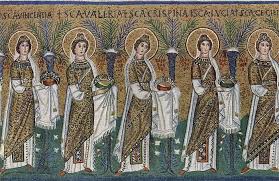
In the context of the modern conservative church as it spans across several theological traditions, it is often said that having women in the pastoral office is a mark of systemic heterodoxy. While this assumption is generally true it is often mistakenly assumed that therefore having women in the office of the diaconate is likewise, in the same way, a mark of systemic heterodoxy or at least the beginning of a slippery slope towards it. This paper will seek to address the issue of female deacons, specifically in the context of theologically conservative churches. In order to do this, we will look at the distinction between the two genders in the creation order, a comparison between the office of the pastor and of the deacon, the history of female deacons, and seek a modern answer to the question of female deacons that is Biblical, historic, and well-reasoned.
Creation Order
In order to discuss gender and its relation to the offices of the church, it is necessary to first build a foundational basis for both the Scriptural teaching on gender as well as on those offices. We see an example of this basis being used in Paul’s prohibition of women in the pastoral office found in 1 Timothy 2:11-14 where Paul says, “For Adam was first formed, then Even. And Adam was not deceived, but the woman being deceived was in the transgression.” This explanation is of great importance for two reasons, firstly, this explanation is in the immediate preceding context for the qualification of ministers which comes just two verses later. This tells us that Paul had the offices in mind while commanding women to be silent in the churches and prohibiting them from teaching or exercising authority over men. More importantly, this also tells us that when we are reading those qualifications for the offices of the church, we need to keep this in the back of our minds, not as a mere cross-reference, but as it was originally laid out as one coherent thought only two verses apart in distance. Secondly, and more importantly, we see from this that Paul is not arguing from the current cultural context but from the garden. As Matthew Henry wisely points out, it is important to note that these are two separate reasons for the prohibition of women teaching and exercising authority over men, not one[1]. The first reason we see is that “Adam was first formed.” In this statement, Paul is drawing the reader’s attention to the creation order as God made it with everything in perfect order. The second reason deals not with the perfect creation of God but with the fall from that perfect order. Some have taken this second reason to be an implication that the fall occurred because Adam and Eve did not live in accordance with God’s created order and therefore see this as a statement of causation[2]. Others, however, understand this to be referring to a ramification of the fall rather than its cause wherein the created egalitarian order is perverted[3]. However, if we look at the text critically, we will see that the first reason Paul gives is a clear rebuke to that line of thinking. For him to first say, “For Adam was first formed, then Eve,” prefaces anything that he says later with the perfect order as it was created as a separate reason in and of itself distinct from the role that Eve played in the fall of man.
This idea of there being a difference between men and women created into the order of nature is found throughout the Scriptures not only in the context of the church, but also in the home (Col 3:18, Eph 5:22-23, and 1 Pet 3:1). Uniquely among these, 1 Cor 11:3 speaks to the distinction between the genders in a way that is restricted to neither church nor home but is broadly stated as a general metaphysical truth that relates beyond creation and points to an analogous picture of the economic distinction found in the inter-trinitarian relationship of the Godhead.[4] In Gen 2:21-23, we see the distinct roles of the two sexes when the Lord, in order to make a helper for Adam, one set for a supportive role, creates her from a rib taken out of Adam’s side. The unity of essence between male and female is found in that the woman is made from the flesh of man, and in turn, man is born from woman. The distinction of economy is conveyed in that she was made in order to support him. Therefore, man and woman are of one human essence but do not serve the same societal function. Secondly, it shows that this distinction was purposely made as part of the human design, analogous of the inter-trinitarian relationship as well as the incarnational redemptive relationship[5]. Thirdly, it shows us that this distinction in economy is a voluntary distinction. Just as the economy of the Trinity is voluntarily distinct necessitated by nothing other than inter-trinitarian love, so are we as Christian men and women called to serve in our respective economies and so doing reflect our Lord, both in the wife submitting in love to her husband (Col 3:18) as well as in the husband leading, guiding, providing for, and sacrificing for his wife out of love (Eph 5:25).
As these things relate to natural order being perverted in the fall, there is lacking any explicit command for Adam to lead his wife but it is implied through Eve’s having been made as a “helper” for Adam. In Eve listening to Satan and feeding enticing Adam to sin alongside her, she was doing quite the opposite of God’s will, serving Adam to his detriment. As a result of this sin, Eve is punished in Gen 3:16 with the curse that she “will desire to her husband but that her husband will rule over her.” This can be interpreted both as a desire for equality or of having authority over the husband, however, the result is the same, because the creation order is suited to neither. This brings the question into account; is the curse the husband’s authority or is it her desire contrary to this authority over her? As we have seen from the creation which was made in all perfection (Gen 1:31), Eve was created as the helper for Adam. For her to be created to be Adam’s helper and then for it to be a curse for him to rule over her may make sense when we cross-reference this with texts that speak of the Holy Spirit as our “helper” such as in John 15:26, but the text of 1 Cor 11 along with every other text on the Son and the Spirits inter-trinitarian relationship show that within a relationship with equality of essence a voluntary submission in economy is not only a holy and right thing but a show of perfect love and harmony as God intended all creation to function. From this, it is clear that the ruling of the husband is not the curse, but her desire contrary to it. Similar to the text of Rom 1 where the curse of God against the persistent unbeliever and unrepentant sinner is more sin and unbelief, the curse upon the disorder of harmonious unity is more disorder and disunity.
The Offices of the Church
With this background of the economic distinction between the sexes as the backdrop for our investigation into the office of deacon, we can now begin looking at the text itself just as we find Paul moving from the foundation of the creation order at the end of 1 Timothy 2 into chapter 3. The first office mentioned here which takes primacy over the other is the office of the pastor which is referred to by other terms such as elder or bishop. This office is one that is comprised primarily of teaching as seen in verse 2 and ruling in authority over the church as seen in verse 5. Both of these things mentioned in the beginning of 1 Tim 3 are strictly forbidden to women in 1 Tim 2:11-12, which, is no doubt intentional on Paul’s behalf having written this prohibition with the qualifications for the pastorate following immediately after it. However, when we come to the qualifications for deacons the issue presented before us is a bit different because the office of the deacon as we see in Acts 6:3-4 when it is instituted is not an office of the word or authority but of a more humanitarian nature, referred to in Acts 6:2 as “serving tables.” A deacon is not a Christian waiter only in the sense that it does not restrict the deacon to waiting on tables. Deacons have also been used as messengers, janitors, treasurers, and a jack of all trades set to the purpose of the administration and work of the church outside the realm of teaching and ruling.[6] What this means is that the deacon in its role set out in Scripture is doing everything but ruling and teaching for the express purpose that the elders of the congregation may focus solely upon prayer and the ministry of the Word. We see this especially in the differences between the qualifications for the two offices. The requirement of any ability to teach for pastors (V. 2) is completely absent from the qualifications of the deacon. This difference makes the most sense of them all since as we have seen in Acts 6:3-4, this office exists for the sole purpose of taking on what would otherwise have been the pastors administrative and humanitarian responsibilities so that he can fully devote himself to the ministry of the Word, to prayer, and to the shepherding of the congregation. The second difference to note between the qualifications for the two offices is that the deacon is not required to be a mature believer. Although deacons are required to first be tested in order to be found blameless (1 Tim 3:10), this testing is an examination of their honesty, wisdom, and of course salvation (Acts 6:3). The maturity of the pastor on the other hand is one bound to the time that has passed since his conversion for the express reason that he does not become prideful. This is only a danger for the novice Christian because the pastor is both ruling over and teaching the congregation, therefore a new believer runs the risk of letting such authority over a group he just joined go to his head. With the diaconate there is no such risk, for there is no authority in waiting tables. The third difference that we see between these offices is in their requirement to be able to rule over their families. In verses 4-5 the pastor is required to rule over their house in a way that his children are “in subjection with all gravity.” Paul elaborates on this emphasis by stating that if a man cannot rule his own house in this way then he cannot rule over a church, which is not only a far larger group of people but the judgment of accountability is harsher and the stakes higher. When Paul goes over the requirement for deacons to rule over their house it is merely stated that they be able to do it well. There is no mention of subjection or gravity, nor is there a reference to how this reflects on his ability to rule the church because ruling belongs to the office of pastor, not of a deacon.
The fundamental point that we should draw from these differences is that one is a direct referent of the previous prohibition and the other is noticeably and likely intentionally lacking that which was prohibited. It is in the context of Paul’s prohibition of women teaching and having authority over men that he gives a description of two offices, one comprised of teaching and ruling and the other comprised of administrative and humanitarian services. It was the pastoral office that served as the referent in mind for his prohibition and argument from creation and the fall. This leaves the diaconate in a sense open to although not commended to women. What this means is that there was never a wholesale invitation for women to enter the diaconate yet there was no prohibition barring them from it. This is very important to note for three textual reasons. Firstly, the institution of deacons specifically commissions the congregation to select seven men to be ordained to this office. This text is found in Acts 6:3 where the congregation is told to select seven men to be appointed unto the serving of tables. Some have taken this text as meaning that the diaconate is closed to women. While this may sound reasonable at first it does not stand up to the necessity that Paul saw in clearly stating that women cannot preach or have authority over men. If choosing men for the diaconate was a clear enough prohibition of female deacons then there would have been no need for such a clear prohibition of it in 1 Timothy 2. Secondly, the Scriptures make reference to female deacons. In Romans 16:1 Phoebe is referred to as a deacon. While it is true that deacon can mean servant in a non-ecclesiastical way, she is not only called a servant but a servant of the church in Cenchreae. This would be akin to introducing your friend to somebody as the shepherd of Cenchreae First Baptist Church in order to convey that he is a layman at that church who works in the sheep industry. The only reason that one would have to read servant in Romans 16:1 as an occupational servant rather than the ecclesiastical office of servant is if we were to presuppose that there was a necessary contradiction between Phoebe and the office of deacon. Thirdly, 1 Timothy 3 gives a unique place to the deacon’s wives. Naturally, there is a “why,” of the specific commission in Acts 6:3 to appoint men for the diaconate. In the context that Paul was writing in, women were almost never mentioned. Although this has become harder to discern in the modern age with inclusive language Bible translations, that does not remove the emphasis on male leadership in the Scriptures. Not only would it have been radical in this context to include women in the first group of deacons ordained in the church but it still would have been unthinkable to appoint women at all for this task when there were fit men who were willing and able. This brings us back to the text of 1 Timothy 3. 1 Timothy 3:11 has been translated in two main ways, one attributes the qualification to the wives of deacons while the other renders it as “likewise the women.” The most important difference is the concept of the possessive pronoun “their,” which is lacking in the Greek.[7] Whether we render this as wives or women is of no effect, but the difference between the women and their women is enormous when we ponder the place that a woman in this context would be relating to the diaconate. However, the difference between the renderings is not one between women in the diaconate and un-ordained wives of the deacons but is only the difference between egalitarianism outside the realm of Paul’s prohibition and male-preference. The reason for this is seen in the lack of a requirement for the pastor’s wives which would logically precede the requirement for the deacon’s wives in successive order as the rest of the text moves accordingly. While this is often titled an argument from silence it is rather more of an argument from intentional distinction or difference. Paul has already in 1 Timothy 2 prohibited women from teaching and having authority over men. He then proceeded to give the qualifications for the office consisting of teaching and exercising authority over the congregation in 1 Timothy 3. What we see then in the portion of this text regarding the diaconate is that women, who we will assume are the wives of the men in the diaconate which is the more likely case regardless of how we translate the text, have a relation to their husband’s office that the pastor’s wives do not. If this were a mere requirement for the un-ordained wife of a church officer it would make more sense to it apply to the wives of pastors rather than the deacons, and if it were applied only to one it would make sense to apply it only to the wives of pastors both because that office has primacy over the office of deacon as well as because that is the logical succession of the text. From this, we can conclude that the relationship that the wives of the male deacons have a relation to their husband’s office that requires them to fit the qualifications. The pastor’s wives are given no such requirements because there is no way for them to relate to their husband’s office without breaching Paul’s prohibition. Therefore, if this text refers to the deacon’s wives then it is clear that they are not given requirements because of their place in the spotlight as examples, but because they are exercising the office of deacon. If they refer to women then the case is open-and-shut. Edward T. Hiscox makes this argument, stating; “deacons’ wives, mentioned in 1 Tim 3 were probably not the wives of deacons… but deaconesses or female assistant, appointed by the churches to minister to the sick and perform other services to those of their own sex.”[8]
Historical Testimony
Having looked thoroughly at the text for an answer to the question of female deacons we might think to ourselves that this is all well and good to see that a sane biblical case could be made for it, but that in reality most churches that have female deacons are liberal and pandering to contemporary society. Part of this concept is derived from the misnomer that historically deacons have always been men and that the church has had a strict men-only policy for both of its church offices across all of time and space. This, however, is not the case. The amount of variance on the office of deacon in the church is truly astonishing to the point that the Roman Catholics for a significant portion of time had largely abandoned the office of deacon altogether from the 5th century when they began to dwindle out of use in the west all the way to the 2nd Vatican council when they were reintroduced.[9] However, in the East, the diaconate never went out of fashion. And wherever the diaconate has existed women have been included in it. We have writings from the fathers as early as the beginning of the 2nd century A.D. such as Clement of Alexandria advocating for a complementarian use of females in the diaconate, saying; “the apostles in conformity with their ministry concentrated on undistracted preaching, and took their wives around as Christian sisters rather than spouses, to be their fellow-ministers in relation to housewives, through whom the Lord’s teaching penetrated into the women’s quarters without scandal.”[10] This practice was in fact so common that further guidelines to the church order respecting the ordination of female deacons were outlined at the council of Chalcedon in 451.[11] There were, however, a selection of obscure councils that contradicted this ecumenically accepted by a wide breadth of churches which include the 1st Council of Orange, the Burgundian Council of Epaon, and the Second Synod of Orleans[12]. It is important to mention that these councils took issue not with women doing the work of the office of a deacon but merely the ordination of them. This seeming discrepancy in the history is mitigated though in that not only are these obscure councils in contradiction to the Ecumenically accepted council of Chalcedon, these councils were right around the time that the abuse of “holy orders” had crept into the church and the diaconate was soon by and large done away with altogether along with the women who once bore its office. As the church moved into the reformation era men such as John Calvin advocated for a reinstatement of females into the diaconate, saying; “Women could fill no other public office than to devote themselves to the care of the poor. If we accept this (as it must be accepted), there will be two kinds of deacons: one to serve the church in administering the affairs of the poor; the other, in caring for the poor themselves.”[13] The next piece of the historical puzzle is at the Westminster assembly where many of the divines thoroughly defended the position that widows, in particular, hold this office of the deaconess. One such is John Gibbon who stated; Widows are church-officers, 1. Because in 1 Tim. 3 there is mention of church-officers, and widows come in among [3:11]. 2. These things agree not to an eleemosynary widow, 1 Tim. 5:9,10. 3. She must have a salary from the church: ergo, an office.”[14] Bringing this discussion finally into the present day with the ultra-conservative Reformed Presbyterian Church of North America who permitted the ordination of women into the diaconate in 1888, which still remains policy in the RPCNA to this day, with no systemic heterodoxy, nor any sign of loosening their grip on ultra-traditional full-subscriptionist Scottish Presbyterianism[15].
Conclusion
All of the work done as part of this paper served unto the purpose of showing that in the midst of all of the theologically loose and ethically liberal churches ordaining women to the diaconate there is a long and almost unbroken line of female deacons from the apostolic era unto the present with no correlation or causation between the women bearing the office of deacon and theological corrosion as has most certainly been the case for those churches ordaining women to the pastorate. A large part of the reason for this is that the position that the church has historically taken on female deacons as we see represented in 1 Timothy 3 and 5 is that they are to be ordained to the diaconate only if they are wives of male deacons, or if they are widows over the age of 60, which is passed the age of fertility. By no means was the historic diaconate an egalitarian playing field, but the deaconesses were subservient within the economy of the diaconate to their husbands, they were not to be ordained into it as individual women unless they were aged widows. The service of these female deacons was to minister to those of their own sex, following the order of creation they were not of equal authority with the males in the diaconate, and of course, outside of the diaconate, the office of deacon bares no authority with it regardless. Therefore, not only does the office of deacon not contradict the female economy, but men were still the leading force within the diaconate with women being ordained into it on the basis of their husband’s relation to the office, or on the basis of their otherwise lack of vocation and protection as the aged widows in 1 Timothy 5. Widows who had children or grandchildren were therefore also not to be deacons according to 1 Timothy 5:4, for not only did these widows have a vocation to attend to but people to care for them. We see therefore that the vocation of the diaconal widow was one that the church granted to them out of benevolence as much as was her service to the church. We see then just how complementarian this position is. Although the diaconate was not barred to women, the women were never invited into it, nor were they regularly sought, but only the wives of church officers and widows with no vocation and nobody to take care of them were ordained into this ministry of the female deacon, so it has at many times and place been and so it shall continue to be.


One thought on “The Conservative Deaconess”