
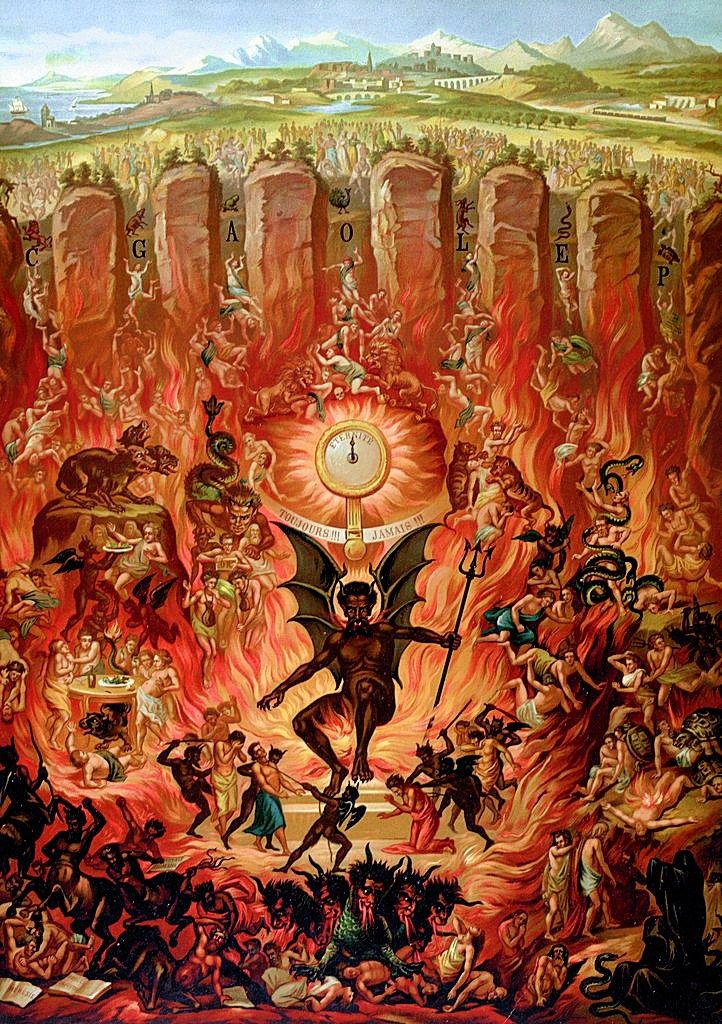
Perhaps you, like me have run into “Evangelicals” as they sometimes call themselves speaking of Hell as this anger management outlet for the potter to throw His carefully crafted vessels at a wall for eternity. Perhaps you, like me once upon a time (probably yesterday), have felt anger and wrath towards your neighbour who does theology wrong or refuses to believe that Christ died for their sins so either by mouth or by heart you scream like the old decrepit curmudgeon of a sinful oaf that you are “burn in heck ye filthy reprobate scum.” Perhaps you, like me, are puzzled by the different views on Hell in the church; that of the liberals, the Romanists, or the fundamentalists and are just hoping for some more clarity in this messy and confusing world that we live in. If you relate to any or all of these, then you have come to the wrong place because I can’t stop “evangelicals” from being the antithesis of their own title, I can’t stop myself much less others from being a sinful font of hatred, and I still see too much through a glass darkly to be able to tell you with clarity what’s on the other side. But stay a while, grab a strong drink and snuggle in while I tell you about Hell and why you need to understand it.
There are many wrong views on Hell but two for tonight will suffice. Firstly, there are those who believe it is not eternal. Whether these individuals opt instead for universalism or annihilationism, their motivation is the same: construct a theology of Hell that makes sense and doesn’t offend me. The second error is that of those who believe that Hell is just another way that God has chosen to glorify and enjoy Himself, by smashing sinners against rocks again and again and again and again and again, because —– GGGGLLLOOOORRRYYYYYY or something. Both errors are encountered often times when either view opens their mouth or puts pen to paper. The Anihallationist confesses that they just didn’t want to be like the evangelical, and the evangelical prays to God “thank you God that you have made me faithful to your Scriptures unlike the Universalist” (see the parable of the Pharisee and the Tax collector for reference). It is from the perspective of the Universalists and Annihalationists that we will seek to tackle this issue. The liberal approaches as they so often do, and says something to the effect of – I believe Annihalationism/Universalism is true because the character of God in Scripture is antithetical to one that would pour out wrath upon sinners for eternity because of sins that they did in their temporal lives for no reason other than gaining unbalanced and overboard retribution for Himself with no reasonable end in sight. To which we would reply (at least I hope we would), “I entirely agree.” Yet, our agreement does not lead us to Annihilationism or Universalism. Why is that? It is precisely because neither perspective is correct.
Dispelling misconceptions:
In order to dispel the idea that the evangelical definition of Hell as everlasting conscious torment is morally repulsive and therefore false, we must ask three clarifying questions: what is Hell, who goes there, and why? The chief error of this conception is not that it places more importance on moral agreeability than it does Biblical accuracy, but rather, it is that it looks at sin and hell outside of and away from its relation to the cross of Christ. In order to construct a functioning understanding of Hell we must go beyond the common assumption that God is holy and sends bad people to Hell because His holiness demands it. In fact, the truth of the matter is entirely different from this assumption.
What is Hell?
Firstly, what is Hell? Hell, as it is commonly understood and spoken of in the modern western context is the Lake of Fire, or as Jesus called it, Gehenna. This lake is described in the Scriptures as being a place of burning in Rev 21:8, a place of destruction for the soul in Matt 10:28, and as the eternal destination of the wicked in Matt 25:41. But this understanding of hell is not the only one. There is another word that was famously translated as Hell in the King James Version that now influences our common understanding of Hell. This other word is Sheol, or Hades, as it is rendered in both the Greek OT and Greek NT. As the Lake of Fire is the eternal place of burning for the wicked, Sheol on the other hand is the universal destination of all men as we learn in Psalm 89:48. For the people of God as we see in Genesis 15:15 it is described as a place of rest, but for the wicked Psalm 9:17 tells us that it is a place of torment. Clearing up any confusion we might have had, these two destinations are distinguished from one another in Revelation 20:14 where Sheol is thrown into the Lake of Fire in an act of final judgement. It is crucial to understand the distinction between Sheol and Hell because one is the final destination of the wicked for eternity while the other is the intermediate state of all the departed out of which the souls of men are redeemed.
Who goes to Hell?
Who goes to Hell? As has been explained, while all men went to Sheol in the OT, not all go to Hell. In several of the texts cited above Hell is named as a place that was “prepared for the Devil and his angels.” It is of first importance that we understand that God did not create Hell for men. Secondly, it is the very purpose of Christ’s mission to be the firstborn from the dead, to be risen up out of Sheol, and lead a host of resurrected saints with Him to His Father (Acts 2:27, Eph 4:8). It is not for a lack of the open-handed offering of salvation to mankind that men reject Christ, but their own rejection of the means of grace (Matt 23:37, Matt 13:18-23). In other words, it is not that God is sending bad people to Hell, for we are all bad people, and it was indeed God who sent Christ His Son to take upon a humanity, to bear our sins, to die for them and to give us His righteousness instead that we might be freed from Sheol and dwell with Him eternally in the new creation. Christ came to die for, to save, and to resurrect the bad people. Paul says in 2 Cor 5:21 that “Christ came to be sin for us, that we might become the righteousness of God,” thus proving that in fact the opposite is true. Not only does God not desire to punish people for their sins but He has gone so far out of His way in order to rescue us from them that He took upon flesh and died in our stead that we might live in His. It is only those who refuse this grace that go to Hell. A perfect example of this is found in Matthew 7:21-23 where it is shown that on the last day individuals will plead their case with God, professing Christ to be Lord and naming off ways that they “served” Him as good and obedience slaves. This totally misses the point of the cross of Christ. We do not call Christ Lord because He demands our obedience and we are obliged to give it. We call Him Lord because He protects us, cares for us, and reigns over us in righteousness and mercy. Likewise, we are not to serve Him for a due payment of salvation, but we serve Him freely because He has saved us. It will never be those who cry out “behold the Lamb of God who takes away the sin of the world, have mercy on us” that will receive the response “depart, for I never knew you.” Rather, it will be those who point to the works that they did, to the feigned obedience that they constructed out of their own imaginations that are turned away.
Why do they go to Hell?
Why do they go to Hell? This is ultimately not because of their sins, for which God held out His motherly wing to gather them as chicks, but ultimately because they would not. Because that would mean that they have to bank their eternity on another, because that means giving yourself up to be crucified with Christ and to live in Him, and for those who cry “Lord, Lord, did I not…” that is simply not acceptable. On that last day, when Christ has finally defeated death, emptied Sheol of His saints and neatly wrapped up this evil age Christ will throw death and Sheol with all of the God-haters in it into the Lake of Fire which was prepared for the Devil and his angels and there they will remain forever. Not because He wants them to, but because regardless of the different eternal circumstances they will always choose the one without God.


